Sunday, December 2, 2018

Congaree National Park

Visited: Sept 2017
Nearby city: Columbia, SC

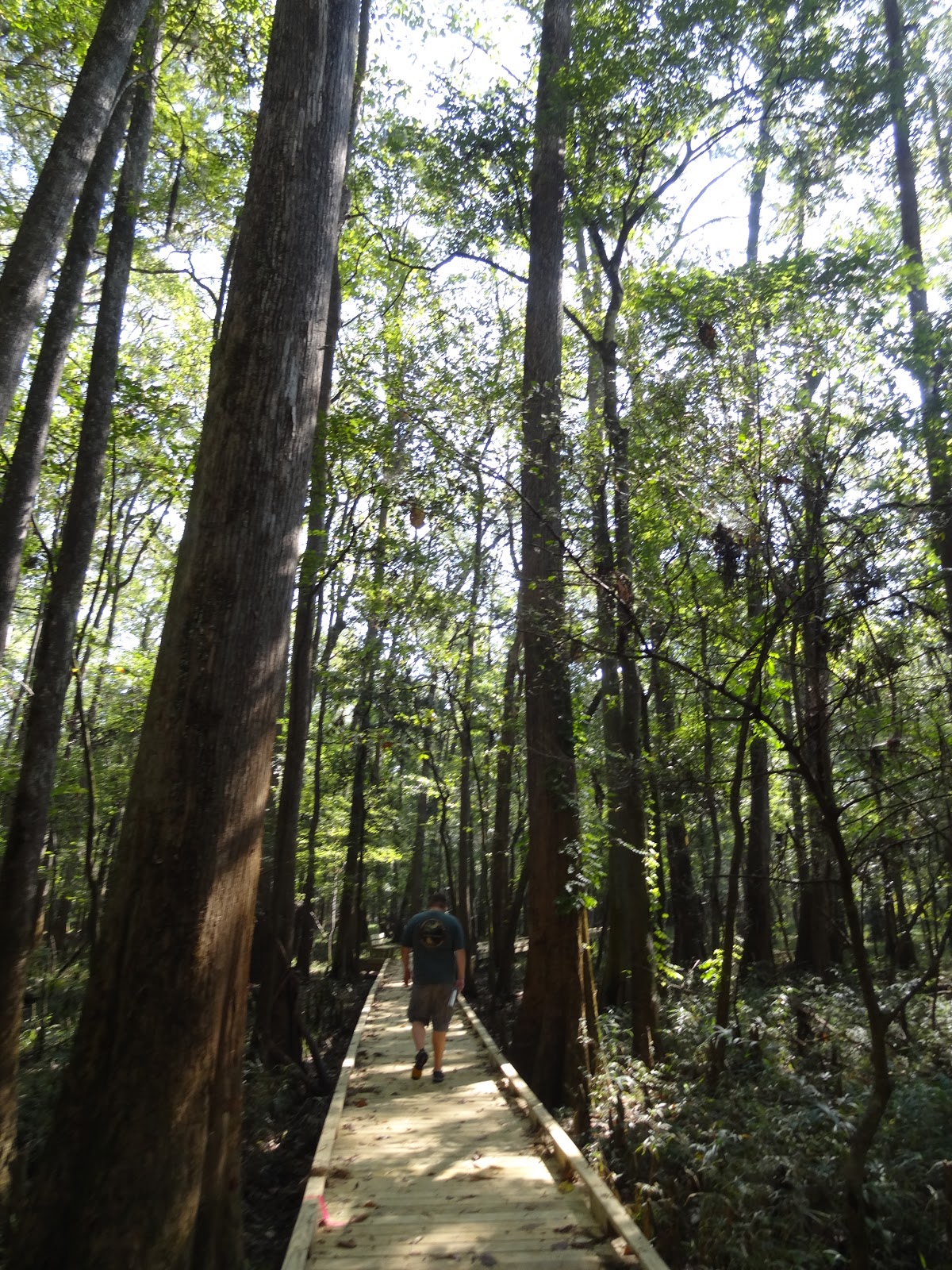
Congaree is a small and unique park in the southeast. South Carolina's lone national park. The Park protects the largest contiguous expanse of old growth bottomland hardwood forest left in the entire United States. The bald cypress, water tupelo, loblolly pine and champion trees you find here are the tallest trees along the East Coast.

Although you might quickly refer to this place as a swamp (even the NPS named it Congaree Swamp National Monument when it was first created in 1976), this place is actually a level floodplain. A swamp is wetland forest that has standing water year-round saturating the land and is occasionally broken up by hammocks, or protrusions of dry land. In contrast, a floodplain is flat land that experiences periodic flooding. Floods in Congaree National Park occur in late winter and early spring. This is the best time of year to visit the Park. Summers are a bad time to visit, due to the mosquitoes. Make sure to bring bug spray. The Visitor's Center has a handy (and humorous) mosquito meter.
The Visitor Center is very convenient to the Park Entrance and should be your first stop to learn about the history of the area. Despite the consistent flooding, this area was not conducive for agriculture. Logging proved very difficult as well, due to the complications of hauling logging equipment in the extremely muddy and wet earth. As logging technology improved, the Sierra Club stepped in, realizing that this kind of forest was disappearing quickly. Congaree Swamp National Monument was created in 1976, and it became a National Park in 2003. 
model tree at the Visitor's Center
The thing to do here is walk the 2.4 mile roundtrip Boardwalk Trail. It's a nice pleasant hike, and gives you a good taste of this environment. It's elevated, so you don't have to worry about getting all muddy. If you wish, there are trails that branch off of the boardwalk, such as the Oak Ridge, Kingsnake, and River Trails. There are also good ranger programs, the most popular being the Owl Prowl, a night time trek into the forest to find these cool birds.


Weston Lake

Tara espied this spider chilling in its beautiful web high above the Boardwalk


Honestly, Congaree is probably a place we would have not gone to but for the goal to visit all National Parks. We did enjoy our stay, but I wouldn't recommend going too far out of your way to visit. That said, it is important that we learn about and protect these unique environments. Walking through the Boardwalk was an interesting journey back in time, and gives you a feel of what most of the southeastern United States looked like before development and civilization. For more info, check out the NPS website: https://www.nps.gov/cong/index.htm

Sunday, November 18, 2018

Top 10 Entrance Signs

We have had so much fun visiting all of our National Parks these past couple of years. As we have visited each one, we get a decorative pin to place on a map to document our travels. Another thing we like to do to keep track of our travels is to take a picture with the Entrance Sign that welcomes us to each Park. 

A lot of tourists like to take pictures of the entrance sign. So there's usually an opportunity for someone to snap a pic for you...and you'll also make instant friends. 😃  If no one is around to take your picture, there is usually some kind of stand to place your camera on (or I guess you could always use the dreadful selfie stick, but usually the signs are too big to do a good selfie).

Some of the National Park entrance signs are strikingly beautiful. This can be due simply because of the setting, or a unique creative design, or even an interesting font. Some are pretty old, built in the heyday of the CCC back in the 1930s. This post will rank our Top 10 Favorite National Park Entrance Signs.


First, an honorable mention:

Glacier National Park, St. Mary Entrance
What a beautiful sign. Located on the eastern edge of the Park at the St. Mary Entrance. First of all, a fantastic setting with a great view of the mountains and secondly, I love how the shape of the sign evokes the fabulous peaks of this jewel of the NPS.

And now the Top 10:

#10. Mesa Verde National Park, Park Entrance Station
This sign was built in the 1930s, when the CCC built trails cut into the mountainside that lead down to the beautiful and mysterious cliff dwellings of this Park. I love the Art Deco font of the sign that perfectly captures the late 20s and early 30s. I also love how the bricks that buttress the sign remind me of the famous cliff dwellings.

#9. Voyageurs National Park, Ash River Visitor Center
Ok, the sign is incredibly basic and is in desperate need of repair (it's all faded, cracked and bleached by the sun). However, this entrance sign is awesome because of the incredible setting. Voyageurs National Park is all about water, so it's only fitting that it's entrance sign lies along the true highways of this park (the extensive network of lakes and rivers). This sign is no where close to a paved road like most other parks, it lies next to the beautiful blue waters of Lake Kabetogama.

#8. Theodore Roosevelt National Park, North Unit Visitor Center
Theodore Roosevelt astride a bucking horse perfectly captures the essence of these epic badlands of the Wild West. Roosevelt spent many years here ranching, mourning the loss of his mother and first wife (who both passed away on the same day), developing a love for nature and wilderness, that inspired him to champion conservation causes as President.

#7. Pinnacles National Park, West Entrance
This unique sign depicts the distinctive craggy peaks of one of our newest National Parks.

#6. Zion National Park, South Entrance
Zion is an embarrassment of riches and this simple, elegant sign is perfectly complemented by the stunning backdrop of the gorgeous canyon. I like how the colors blend together so that the sign almost appears as a natural feature.

#5. Mammoth Cave National Park, Eastern Entrance along Cave City Road
The traditional, iconic brown-and-white NPS design is used to great effect for this beautiful sign. The lovely, forested setting doesn't hurt either.

#4. Mt. Rainier National Park, Nisqually Entrance
The sign itself is rather basic and unimpressive, but the way it's placed over the road?...Wow! Awesome. This is an exceptional gateway to an exceptional park.

#3. Grand Teton National Park, South Entrance (Gros Ventre Junction)
Points for setting and scenery, points for design, and points for that distinctive rustic, Western look. There's something about this sign that just screams "National Park" to me. Love it.

#2. Sequoia National Park, Ash Mountain Entrance
This sign was built by the CCC in 1935 and is famous for its carved Native American face. It is definitely a relic of its time (I can't imagine the NPS designing a sign like this today), and I appreciate its uniqueness and intricate design. Landscape architect Harold Fowler sketched the profile using the Indian Head Nickel (aka Buffalo Nickel) as a guide. The Native American depicted is allegedly Sequoyah, the Cherokee chief and namesake of the mighty trees found here. Supporting the sign is a four foot diameter sequoia log that had fallen in the Giant Forest.

#1. North Cascades National Park, Western Entrance
The NPS went all out on this one. I love it! This incredibly unique, detailed, and intricate sign is less an Entrance sign, and more of an Entrance diorama. Its a perfect way to greet you to this incredible wilderness. The best National Park entrance sign in the country. It rocks!

Sunday, October 28, 2018

Alcatraz Island

Visited: June 2014
Nearby city: San Francisco, CA

"If you disobey the rules of society, they send you to prison; if you disobey the rules of prison, they send you to us. Alcatraz is not like any prison in the United States. Here, every inmate is confined alone. To an individual cell...I don't have good conduct programs, I do not have inmate counsels. Inmates here have no say in what they do; they do as they're told. You're not permitted to have newspapers or magazines carrying news; knowledge of the outside world is what we tell you. From this day on, your world will be everything that happens in this building."
-Patrick McGoohan as the Warden, from the 1979 film "Escape from Alcatraz"

In the sparkling waters near the entrance of the San Francisco Bay sits a tiny island that once housed perhaps the most (in)famous prison in the entire world. Known as "The Rock" the Alcatraz Federal Penitentiary was specifically designed and, thanks to the natural setting, to be virtually inescapable. 

Before it became a prison, the island was home to a military garrison after the U.S. acquired this territory after the Mexican War in 1848. During the Civil War the fort saw no battles, but it was used to imprison Confederate sympathizers and privateers. At the outbreak of the Spanish-American War, the fort was exclusively used as a military prison. 

In 1934, the main cell unit was built and the island was used as a federal prison. Inmates who caused trouble at other federal prisons would be sent to Alcatraz. They essentially put all the rotten eggs into one basket. For the next 30 years, the prison would hold some of the most notorious criminals in American history: Al Capone, Machine Gun Kelly, Robert Stroud (the "Birdman of Alcatraz"), Mickey Cohen, and Creepy Karpis. 

The prison proudly boasted that there were no successful escapes from Alcatraz. 36 prisoners made a total of 14 separate attempts to escape. 23 were caught, 6 shot and killed in their escape, 2 drowned, and 5 went missing, never to be seen again, presumed drowned. 

In 1946, a failed escape attempt led to the deaths of 3 convicts and 2 correctional officers, and 11 more officers wounded in what is now dubbed "The Battle of Alcatraz." In June 1962, Frank Morris, John Anglin, and Clarence Anglin conducted an elaborate escape attempt involving papier-mache dummies with human hair stolen from the barbershop as decoys, an electric drill improvised from a vacuum cleaner motor to chisel away at the cell walls, and a makeshift inflatable raft made from 50 stolen raincoats. The three fugitives did make it off the island in their raft, but no evidence ever emerged that they reached the mainland. In 1979, the FBI suspended the investigation and concluded that they drowned during their escape attempt. This story was popularized in the Clint Eastwood film "Escape from Alcatraz."

On March 21, 1963, after reports showed that the cost of housing inmates in Alcatraz was much more expensive than other prisons and more importantly, that the decades of salt water saturation had severely eroded the buildings and would require prohibitively expensive repair, the prison was permanently closed.

The prison sat abandoned for many years. In 1969, a group of Native Americans (mostly students) occupied the island for 18 months to protest Bureau of Indian Affairs Indian Termination Policy which would have ended federal government's recognition of Indian Tribes. During the occupation, the recreation hall, Coast Guard quarters, and the Warden's home were destroyed by fire. The protest ended when President Nixon rescinded the BIA's termination policy and established a new policy of self-determination and independent Tribal sovereignty. Graffiti from the occupation is still visible throughout the island.

In 1986, the island became a National Historic Landmark and is now managed by the NPS as a part of the Golden Gate National Recreation Area. Tours are very popular and I would recommend getting your tour ticket (15 minute ferry ride from Pier 33 included) very early when you plan your trip. You will find it difficult to buy a ticket on the same day you want to visit. Touring Alcatraz is a highlight for any trip to the Bay Area.

We took the very first ferry of the day for the tour. It was an overcast, rather ominous day for our ride over to the island.

the prison looms in the distance


graffiti from the Native American occupation on the water tower
Your tour will include headsets and an audio recording that will tell you all the history and juicy stories of Alcatraz. Make sure to take your time and listen to everything.
these are the ruins of the military garrison, the first building on the island


typical cell

"Every window in Alcatraz has a view of San Francisco" -Susanna Kaysen


a makeshift tool used to widen the bars of the cell and attempt escape


the lighthouse

the warden's home. All prison staff also lived on the island

view of downtown San Francisco


replica of the dummy used in Frank Morris's famous escape

the cafeteria

menu from March 21 1963, the last meal served at the prison

a good way to keep track of all the cutlery in the kitchen...wouldn't want this to fall in the wrong hands


on our way back to the mainland
Alcatraz is a must see for the Bay Area and well worth a visit. For more info: https://www.nps.gov/alca/index.htm. Again, make sure you get your tickets early (at least a couple of weeks).