Sunday, November 14, 2021

Antietam National Battlefield

 
Visited: Sept 2019
Nearby town: Sharpsburg, MD; Frederick, MD

"In the time that I am writing, every stalk of corn in the northern and greater part of the field was cut as closely as could have been done with a knife, and the slain lay in rows precisely as they had stood in their ranks a few moments before. It was never my fortune to witness a more bloody, dismal battlefield."
-Union Maj. Gen. Joseph Hooker

September 17, 1862 - the single most bloodiest day in United States history.

On that day, the gentle, rolling hills and serene meadows of Western Maryland witnessed a tremendous and terrible battle.

The Civil War had been raging for nearly 18 months. By the end of the summer of 1862, the Confederate Army of Northern Virginia again repelled the Union Army at the Second Battle of Bull Run. In addition, Union General McClellan's planned invasion of Richmond, the Peninsular Campaign, stalled and sputtered. After suffering heavy losses, the Union abandoned the invasion and withdrew.

These victories emboldened Confederate General Robert E. Lee. He decided to make a daring move. He decided to invade Union territory by advancing his army into Maryland. Lee predicted that moving the action north would relieve war-torn farms in Virginia, and enable him to re-supply his own army. Lee also thought that Maryland would be a good place to initiate an invasion because Maryland was a slave state and many of its citizens were sympathetic to the Confederate cause. Lee thought there was an outside chance that Maryland might welcome his army or even secede from the Union and join the Confederacy. Furthermore, Lee hoped that military victories on Union soil would destroy Northern morale as the midterm elections approached; convince Northern leaders to abandon their goal of reuniting the nation and broker for peace; and encourage foreign powers, particularly Britain and France, to officially recognize the Confederate government.

Lee began to move his army north and into Maryland in early September 1862.

The Union Army of the Potomac took notice of Lee's movements to the north. They figured that the Confederates planned to attack Union soil. On September 7, the Army of the Potomac, led by George B. McClellan, marched north of Washington DC into Maryland, parallel to Lee's army, with orders to pursue Lee and cut off any attack. McClellan's forces were huge, numbering approximately 102,000 men, including six infantry corps, led by Joseph Hooker, Edwin Sumner, Fitz John Porter, William B. Franklin, Ambrose E. Burnside, and Joseph K. Mansfield, respectively. McClellan's pursuit of Lee was slow and cautious. McClellan's overly cautious approach had led to the failure of the Peninsular Campaign; however, Lincoln respected McClellan's organizational skills, training abilities, and knew that McClellan enjoyed fierce loyalty among his troops. Therefore, even though the Cabinet insisted that McClellan was unfit for command, Lincoln retained McClellan as head general of the Army of the Potomac despite his previous failures. 

Lee's plan involved a risky maneuver. Lee decided to split his 55,000-strong force into two. One contingency, led by Stonewall Jackson, would attack the federal arsenal at Harper's Ferry, and then the other, led by Lee himself and James Longstreet, would simultaneously attack the city of Hagerstown and cut off the Baltimore & Ohio Railroad, which provided crucial supply to Washington DC. 

These plans - known as Special Order 191 - were distributed to the Confederate officers. A copy of these orders became lost somewhere in transit. On September 13, a Union Corporal, Barton Mitchell, just happened to discover this copy lying in the grass at a campground recently vacated by Confederate troops, wrapped around three cigars. McClellan could not believe his luck. He now knew the detailed plans of Lee, and more importantly, he knew that Lee was splitting his forces into two, thus subjecting each cohort to isolation and defeat if McClellan acted quickly. Incredibly, despite this knowledge, McClellan waited nearly an entire day before positioning his troops to intercept Lee's splintered army.

In a somewhat ironic twist, Confederate spies alerted Lee that McClellan was moving quickly - or, at least, quickly for McClellan. Too quickly. McClellan's "aggressive" action was so out of character, Lee surmised that something was amiss. Lee suspected that, somehow, McClellan had caught wind of the Special Order. Lee took action to mitigate this potentially disastrous scenario. Lee was able to concentrate most of his forces at the village of Sharpsburg, on the western bank of the Antietam River.          

The Union army arrived at the eastern bank of the Antietam River on the evening of September 15. If McClellan had attacked at that moment, his forces would likely have overwhelmed the vastly outnumbered Confederate army. However, due to McClellan's overly cautious nature, he wrongly assumed Lee's troops were much more numerous then they actually were, and instead bunkered down. McClellan would not attack for another day-and-a-half, thereby allowing Jackson's troops to arrive and reinforce Lee's army. The extra time also allowed Lee to fortify a position at Dunker Church. Lee placed main artillery and cannon in the field next to the Church.
Dunker Church


The battle commenced on the early morning of September 17. Union Gen. Hooker led the initial assault. His troops attacked from the north on the Confederate's left flank, with plans to pierce the line and overrun the fortification at the Dunker Church. A cornfield provided cover as Hooker's troops approached. However, once the troops emerged from the cornfield, they were met with a terrible and terrific volley from Jackson's division, positioned at the Church. For the next four hours, the cornfield changed hands again and again as both sides attacked and counterattacked. The carnage was brutal, one Lousiana Brigade suffered 60% casualties in 30 minutes. Losses were incredibly heavy, thousands of troops on both sides lay in the cornfield, dead and dying. 
the hallowed grounds of the Cornfield


After this bloody and brutal seesaw in the cornfield, the Union army was finally able to push through and occupy the grounds near the Dunker Church at approximately 10:00 in the morning.

Among the Union troops was a brave nurse known as the "angel of the battlefield". Arriving at the cornfield at noon, she did her best to comfort and aid the wounded. The nurse risked her own life doing this work, for as she offered this assistance, bullets still whizzed in the air and artillery boomed in the distance. She later recounted:

"A man lying on the ground asked for a drink - I stooped to give it, and having raised him with my right hand, was holding the cup to his lips with my left, when I felt a sudden twitch of the loose sleeve of my dress - the poor fellow sprang from my hands and fell back quivering in the agonies of death - a ball had passed between my body - and the right arm which supported him - cutting through the sleeve, and passing through his chest from shoulder to shoulder. There was no more to be done for him and I left him to rest. I have never mended that hole in my sleeve."

This nurse was, of course, Clara Barton, who would later found the American Red Cross.


the New York Monument


By midday, the action had shifted to the center of the Confederate line. South of the Dunker Church, the Confederate line ran along a "sunken" road. The Confederates along this road, led by Maj. Gen. D.H. Hill, held strong against the Union assault for over three hours. Eventually, after heavy losses, the Union army was able to take the road. However, the troops were so exhausted after taking the road, and the scene so chaotic, that no further assault was taken. Ultimately, neither side gained a decisive advantage. This sunken road was the scene of perhaps the bloodiest and costliest fighting in the entire war. Over 5,500 soliders were killed or wounded in three hours of battle in this spot alone. For years afterwards, veterans referred to the sunken road as "Bloody Lane."


Bloody Lane

The action then shifted to the southern end of the battlefield. Union Maj. Gen. Burnside was tasked to cross the Antietam River at the Rohrbach's Bridge and take the high ground on the bluffs on the western side of the river. The Confederate troops occupied these bluffs, but the forces there had been depleted as Lee redeployed the troops to the left flank at the cornfield and at the sunken road. By 10:00 am, only 3,000 Confederate soldiers, led by Brig. Gen. David Jones, were left to meet Burnside's troops at the river. Although vastly outnumbered, Jones occupied the high ground, and Burnside's troops were exposed along the river bank as they tried to cross the bridge. Burnside tried to cross the bridge, but was repeatedly repelled by Confederate fire and was forced to fall back after suffering heavy losses. Finally, on the third attempt, Burnside was able to advance across the bridge and push back Lee's right flank. Despite successfully taking the bridge, Burnside had been held up by Jones's men for nearly three hours and had taken heavy losses. Once again, the battle was effectively a stalemate. The bridge is now known as Burnside's Bridge.

Burnside Bridge


The battle ended at approximately 5:30 p.m. The Union had suffered 12,410 casualties with 2,108 dead. The Confederates had suffered 10,316 casualties with 1,547 dead. A staggering total of 22,726 casualties in a single day. An additional 1,910 Union soldiers and 1,550 Confederate soldiers died of their wounds shortly after the battle. More Americans died in battle on September 17, 1862, than on any other day in the nation's history.

The Union referred to the battle as Antietam (after the river), and the Confederates referred to the battle as Sharpsburg (after the village).  

Facing these incredible losses, Lee decided to withdraw his forces across the Potomac and retreat back into Virginia on the evening of September 18. Although the Union suffered more losses than the Confederates, the Confederates were driven from the field of battle and decided to end their planned invasion. As Lee retreated, McClellan elected not to pursue Lee across the Potomac and deliver a potentially crippling blow to the Army of Northern Virginia, despite repeated entreaties from President Lincoln. Eventually, Lincoln had enough of McClellan's overcautiousness. The battle had concluded in a draw, but it could have been a decisive victory if McClellan had simply been more aggressive. On November 5, Lincoln relieved McClellan of command. Lincoln replaced McClellan with Ambrose Burnside. 

Although the battle was tactically inconclusive, historians generally agree that Antietam was a strategic victory for the Union. The Confederates had withdrawn first and abandoned their planned invasion of the North. That was enough of a victory to persuade Lincoln to issue the Emancipation Proclamation, freeing the slaves in Confederate-controlled territory, and transformed the purpose of the war to not only perserving the Union, but also abolishing slavery. With emancipation being a stated goal of the Union campaign, Britain and France - countries that disliked slavery and had abolished slavery years earlier - decided not to officially recognize the Confederate government.  

Antietam National Battlefield was established to commerate the site in 1890. Be sure to visit the Museum, Visitor's Center, the cemetary, and take the auto-tour around the battlefield. Every American should visit these hallowed grounds.

Sunday, October 24, 2021

Harpers Ferry National Historical Park


Visited: Sept 2019
Nearby town: Harpers Ferry, WV

"Here, before God, in the presence of these witnesses, from this time, I consecrate my life to the destruction of slavery!"
-John Brown, to the congregation of a church in Hudson, Ohio, after the 1837 murder of abolitionist Elijah Lovejoy by a pro-slavery mob

What makes a man a hero? What makes a man a traitor?

I guess it might depend on who you ask.

Harpers Ferry National Historical Park relates the story of one John Brown, a surveyor and tanner turned abolitionist, who thrust himself into the national spotlight when he conducted a raid on a federal armory in order to start an uprising that he hoped would lead to the end of slavery.

John Brown was born on May 9, 1800 in Torrington, Connecticut. As a young boy, Brown's family moved to the Western Reserve (present-day northeastern Ohio), which was one of the most anti-slavery regions in the entire country. Brown's religious upbringing and the influence of his father, who offered his home as a refuge for fugitive slaves on the Underground Railroad, led the young Brown to abhor slavery. As an adult, Brown became an ardent abolitionist and activist. Brown grew weary of legal efforts to end slavery and felt that something more needed to be done, even violence itself, to bring about the end of slavery. He became frustrated with abolitionist pacifists, deriding them as "men [who] are all talk. What we need is action - action!" Brown believed that he was directed by God himself to destroy slavery. 

In the mid-1850s, Brown made his way to the Kansas Territory. The Kansas-Nebraska Act of 1854 put the question of whether Kansas would enter the union as a "free state" or a "slave state" to the voters themselves. Pro-slavery and anti-slavery factions in the territory clashed repeatedly...the conflict became known as "Bleeding Kansas." On the night of May 24, 1856, in response to the sacking of the town of Lawrence by pro-slavery forces three days earlier, Brown and his band of extremist abolitionists, armed with swords, rounded up five militant pro-slavery settlers and killed them in front of their own families. The tragic and brutal event (dubbed the "Pottawatomie Massacre") made John Brown infamous. Both sides of the debate were horrified by Brown's actions; Frederick Douglass, upon hearing the news, remarked that it was "a terrible remedy for a terrible malady."

After the bloodshed of Kansas, Brown began planning to initiate a slave revolt to bring about the end of slavery. 

The quiet village of Harpers Ferry (then in the state of Virginia, and now in present-day West Virginia), was the scene of Brown's bold, and perhaps quixotic, mission.

Harpers Ferry, WV

In 1794, US Congress designated Harpers Ferry as the site of a federal armory due to its proximity to Washington DC and its strategic location at the junction of the Potomac and Shenandoah Rivers. In 1830, the Baltimore and Ohio Railroad constructed a railway that crossed the Potomac into the center of the town, right alongside the armory for quick access to the arsenal from the DC area. 

Brown's plan was to lead a group of men to sneak into town and take over the arsenal. Once they had access to the thousands of firearms stored there, they would go about the countryside freeing slaves, arming them, and hoping they would join in a revolt against their masters that would engulf the entire country, and thus, end slavery. Brown attempted to enlist both Harriet Tubman and Frederick Douglass in his takeover of the arsenal, but illness prevented Tubman from joining, and Douglass was convinced that the plot was pure madness and certain suicide.

Brown rented a cabin about 4 miles north of town, under the pseudonym of Isaac Smith. He lived there for a number of months planning the attack, and told curious neighbors that he was mining. In the end, Brown only managed to cobble together a group of 22 men (16 white, 5 black) to invade the armory. 

Brown's men raided the armory on the night of October 16, 1859. They approached the armory from the railroad bridge across the Potomac River. The first casualty of the raid was Heyward Shepherd, a free Black who worked as a luggage handler at the Harpers Ferry train station. When the raiders first spotted Shepherd at the station that night, they ordered him to halt and Shepherd did not to do so, and instead turned and ran. Shepherd was shot in the back.

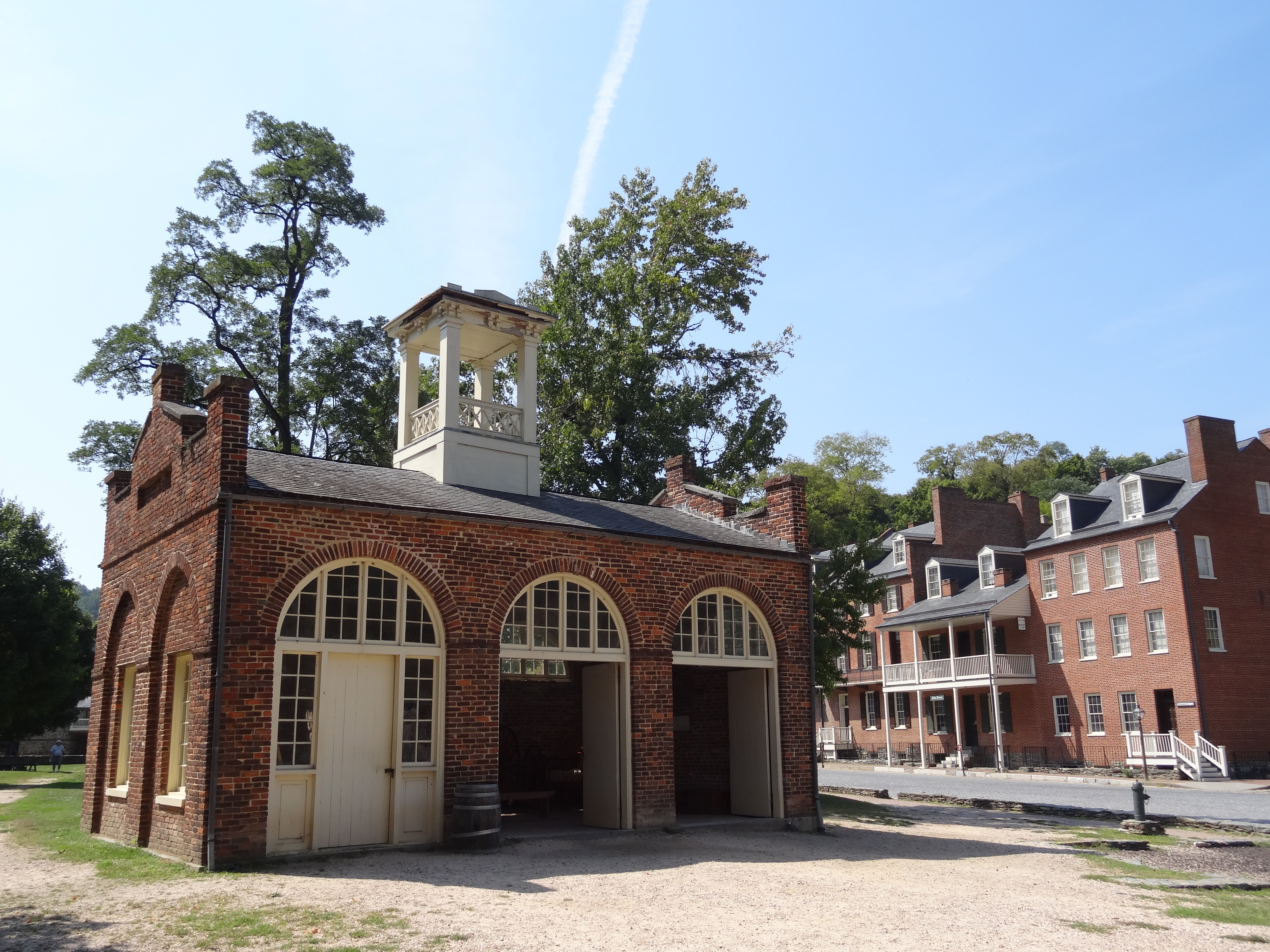
The raiders cut the telegraph line and detained a train that came through in the early morning hours of October 17. The raiders detained the train for approximately 5 hours, but then let it proceed on its route without further incident. Brown later regretted this action and referred to it as his "one mistake" during the failed raid. As armory employees began to show up to work later that morning, the band took them hostage. Brown kept most of the hostages in the armory's fire engine house.

the fire engine house, now referred to as "John Brown's Fort"

As it approached noon, Brown realized that the spontaneous uprising among the slaves in the area did not materialize as he had anticipated. Furthermore, the raiders path of escape was now blocked by armed local milita units. Brown and his remaining men holed themselves up in the fire engine house. 

Once President James Buchanan heard news of the takeover, he sent out the Marines, led by General Robert E. Lee, to Harpers Ferry with orders to quell the rebellion. The troops arrived via rail the evening of October 17. 

The next morning, October 18, Lee and his troops attacked the engine house. When all hope was lost for Brown, Lt. J.E.B. Stuart approached with a flag of truce and informed Brown that if his men surrendered, their lives would be spared. Brown refused, and the marines then quickly crushed the raiders and subdued them. Two of the raiders were killed in the attack, and the rest were taken prisoner (including Brown himself). The hostages were freed and the assault was over. It lasted only three minutes. 

The aftermath of the three-day raid: eleven of Brown's men, one US Marine, and 6 civilians were killed. About a dozen more were wounded.

Brown was arrested and hastily prosecuted by the legal system. A grand jury charged Brown with treason against the state of Virginia, murder, and inciting a slave insurrection. A jury found him guilty on all charges approximately one month after the incident itself. He was sentenced to death and was executed by hanging on December 2, 1859. Among the crowd at the execution was poet Walt Whitman and the actor John Wilkes Booth. The rest of John Brown's raiders were executed on December 16, 1859 and March 16, 1860. 

Brown's eloquent defense of his actions during his trial garnered sympathy in the anti-slavery regions of the North. Although they may not have necessarily agreed with Brown's methods, they realized that Brown was attempting to abolish slavery when other methods had not achieved that goal. On the other hand, white Southerners regarded Brown as a dangerous and deranged radical. An evil traitor to the country and their way of life. Many pro-slavery advocates feared that more and more abolitionists would likely take up Brown's banner and foment additional slave uprisings. They argued that the only way to preserve their way of life was secession from the Union.

In many ways, Brown's raid on Harpers Ferry was a point of no return for the antebellum US. It was apparent that, at this point, the slavery question could only be settled through violence. A civil war was inevitable. Brown concluded as much in his final words before his execution: "I am now quite certain that the crimes of this guilty land will never be purged away; but with blood. I had as I now think vainly flattered myself that without very much bloodshed it might be done."

During the war, the Union considered Brown a martyr, an anti-slavery icon, and a hero. "John's Brown Body" (sung to the tune of "Battle Hymn of the Republic") was a popular song among the troops:

John Brown's body lies a-moldering in the grave
But his soul goes marching on
The stars above in Heaven are looking kindly down
On the grave of old John Brown
Glory, Glory, Hallelujah
His soul goes marching on
He captured Harper's Ferry with his nineteen men so true
He frightened old Virginia till she trembled through and through
They hung him for a traitor, they themselves the traitor crew
But his soul goes marching on
Glory, Glory, Hallelujah
His soul goes marching on 

Today, you can visit the site of this Tragic Prelude, this dress rehearsal as it were, of the Civil War at Harpers Ferry National Historical Park. 

To visit, you first park on the hill overlooking town, and then take a free shuttle down into the historic center. Most of the town is within park boundaries. 
park entrance sign at the public parking lot

Wander your way through the town. There are lots of historic buildings to explore. The Visitor Center has an absolutely great museum about John Brown's life and the raid.


Make sure to explore the scenic beauty of the area. The railroad bridge also serves as a portion of the Appalachian Trail. This is a beautiful part of the country. Take a stroll along both the Potomac and Shenandoah Rivers.


So, what to make of a figure like Brown? Were his actions really necessary to bring about the abolition of slavery? Should one resort to extra-judicial methods or violence in the face of what one perceives to be an unjust law and/or an unjust system? Going back to the question I posed at the beginning of this post: "What makes one a hero? What makes one a traitor?" ... the Visitor Center doesn't really answer that question, however, I think it did an excellent job trying to be objective as possible, detailing all the facts, and allowing visitors to come to their own conclusion.

Learn more about Harpers Ferry National Historical Park here: 

Sunday, October 17, 2021

Appomattox Court House National Historical Park

 
Visited: Sept 2019
Nearby town: Appomattox, VA; Lynchburg, VA

"I at once sent word, however, to have it [the cheering] stopped. The Confederates were now our countrymen, and we did not want to exult over their downfall."

-Gen. Ulysses S. Grant, ordering his troops to quit cheering after they received news of Lee's surrender

April 1865 - the Civil War had been raging for four years. The Confederate Army had proved resilient against Union efforts to subdue their insurrection. After cycling through a number of generals to lead the Union army, Lincoln had finally found his man: Ulysses "Unconditional Surrender" Grant. After Grant's impressive and critical victories at Fort Donelson (1862), Vicksburg (1863), and Chattanooga (1863); Lincoln promoted him to be the head of the Union Army. Like Lincoln, Grant realized the necessity that the Confederates unconditionally surrender to the Union Army. It was clear that any kind of negotiated or brokered peace with the Confederates would preserve slavery within the country's borders...a resolution that was absolutely unacceptable to the Lincoln administration. Grant's strategic skill and tenacity was exactly what Lincoln needed to force an unconditional surrender.

In May 1864, Grant conducted the Overland Campaign, waging a number of battles throughout Virginia that positioned the Union troops to lay seige on Confederate General Robert E. Lee's troops in the cities of Petersburg and the Confederate capital of Richmond. This seige lasted for nearly 10 months. Finally, in late March 1865, Lee became desparate. Short on supplies and rations, Lee ordered a nighttime retreat from Richmond to attempt to meet up with Confederate Gen. Joseph E. Johnston's troops in North Carolina, and then these combined troops could stage a counterattack against Grant's forces and break the seige.

Union cavalry, under command of Gen. Philip Sheridan, pursued Lee's troops and cut them off at the village of Appomattox in central Virginia. On the morning of April 9, 1865, Lee decided to make one last-ditch effort and attack. He assumed that only Sheridan's light-armed cavalry had pursued them to their position...but Union infantry had followed behind Sheridan. Therefore, the cavalry was supported and reinforced by two corps of Union infantry. When Lee discovered this he said "Then there is nothing left for me to do but to go and see General Grant, and I would rather die a thousand deaths." Lee's army was ragged, many with no shoes, and provisions so low that many were starving...he had no choice but to surrender.

Lee rode out to meet General Grant. At the same time, he sent General James Longstreet and his aides to the Union lines with a white linen dish towel to serve as the Confederate flag of truce. Union General George Armstrong Custer (yes...THAT Gen. Custer), leading one of Sheridan's cavalry units, met with Longstreet after a truce had been arranged. Longstreet inquired of the terms for surrender. Custer apparently uttered: "In the name of General Sheridan, I demand the unconditional surrender of this army." Longstreet said he could not do so, but asked Custer that the truce be respected until Lee met with Grant.

Meanwhile, Grant met with Lee to formally accept the Army of Northern Virginia's surrender. This meeting took place at the home of Wilmer McLean in the village of Appomattox. If McLean's name sounds familiar...his home was also the site of the first major battle of the Civil War, the Battle of Bull Run/Manassas. After the carnage at Bull Run, McLean, a wholesale grocer, decided to move his family out of harm's way...further south to the village of Appomattox. Ironically, McLean's property was the site of both what was effectively the beginning and the ending of the Civil War.

You can visit McLean's home at Appomattox Court House National Historical Park. They have arranged the parlor to look as it did when Lee surrendered to Grant.


The two powerful generals met in this room on April 9, 1865. They had not seen each other face-to-face for nearly two decades, when they both served in the U.S. Army during the Mexican-American War in the late 1840s. The contrast between the two could not have been more jarring. Lee was well-groomed and dressed in his ceremonious white uniform. Grant arrived in his mud-spattered government-issued sack coat, with his trousers tucked into his muddy boots. 

Grant gave his terms - Lee's troops would give up their arms and artillery to the Union army, but they were allowed to keep their horses. Lee's troops would be given a parole (in which they promised not to take up arms against the U.S. government), and could return to their homes. The soldiers would not be imprisoned or prosecuted for treason, as long as they honored the parole. Grant also provided Lee's starving army with a supply of food rations. The terms were as generous as Lee could hope for -- and he told Grant that the food rations would do much toward reconciling the country. Lee never forgot Grant's magnanimity on this occassion, and would not tolerate an unkind word spoken of Grant in his presence for the rest of his life.

On April 10, Lee gave his farewell address to his army. On April 12, the Confederate army marched through Appomattox and surrendered their arms and colors to the Union Army. Over 28,000 Confederate troops surrendered. Although a few skirmishes were fought afterwards in Texas, Lee's surrender effectively ended the Civil War. The war was over -- but the toll was devastating. Hundreds and hundreds of thousands of lives had been lost. Yet, the Union was preserved and slavery was abolished.

Appomattox Court House National Historical Park was established in 1935. The site preserves dozens of historic buildings. Make sure to spend some time going through all the exhibits and watch the interpretive videos at the fantastic Visitor Center.
the old courthouse now serves as the Park's Visitor Center


The Clover Hill Tavern was built in 1819. The Union Army used this building to print out the paroles that were issued to Confederate soldiers to allow them to return to their homes.


inside the Clover Hill Tavern over 30,000 paroles were printed


this building served as the Appomattox County Jail


Plunkett-Meeks general store (on the left) and Woodson Law Office (small building on the right)


Visit this hallowed ground at Appomattox Court House National Historial Park to learn more about the end of the Civil War. For more info: https://www.nps.gov/apco/index.htm