Visited: Nov 2022
Nearby town: Eads, CO
"Damn any man who sympathizes with Indians! I have come to kill Indians, and believe it is right and honorable to use any means under God's heaven to kill Indians.
Kill and scalp all, big and little; nits make lice."
Col. John Chivington
commander of the U.S. Volunteers, 3rd Colorado Cavalry Regiment
A lonely, remote windswept plain along the Big Sandy Creek in eastern Colorado is the site of one of the greatest atrocities committed by the U.S. Army against the Native American peoples.
On November 29, 1864, a 700-man force of the Third Colorado Cavalry, led by Colonel John Chivington, attacked and destroyed a village of peaceful Cheyenne and Arapahoe, who had been promised protection by the U.S. Army. More than 150 Native Americans were slaughtered, about two-thirds of whom were women and children.
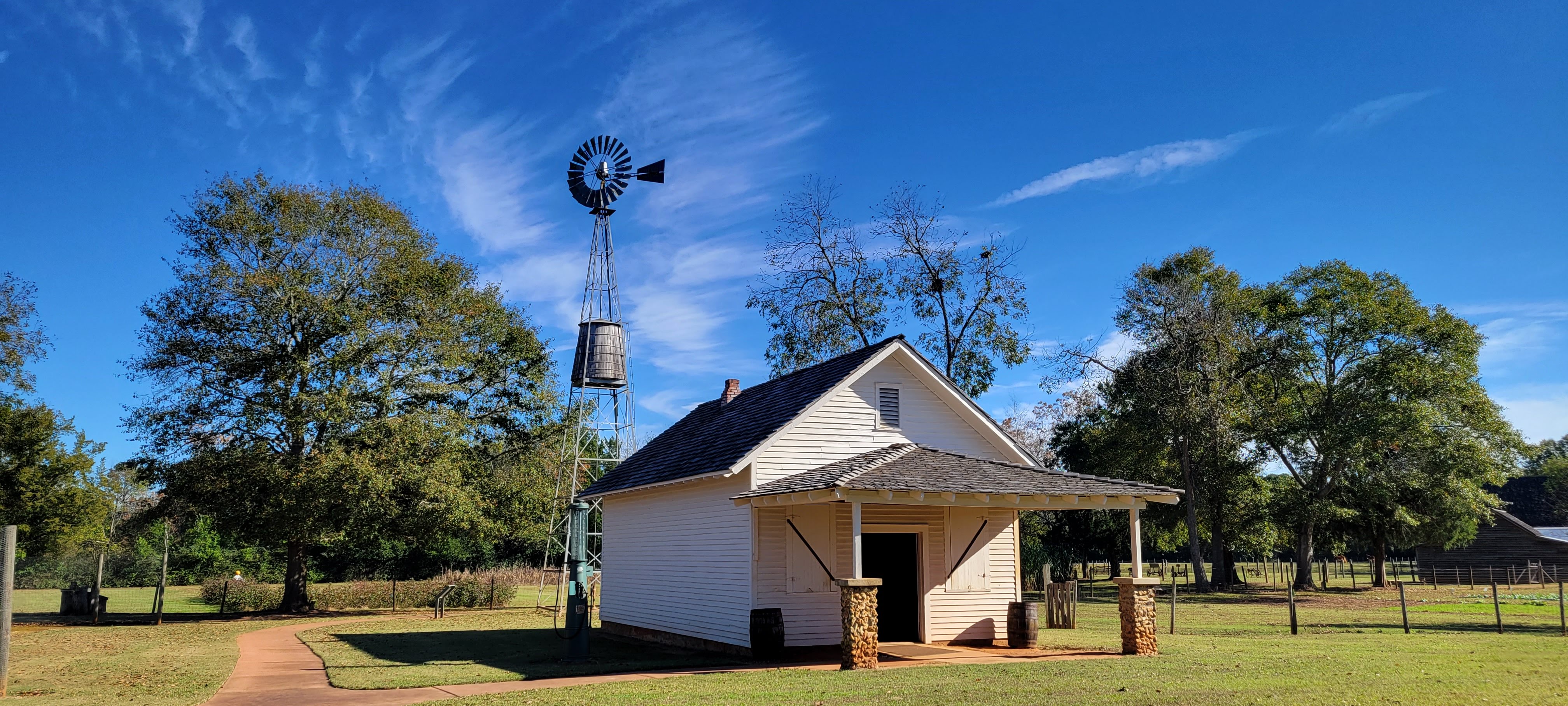
Learn about the events leading up to the massacre at the Visitor's Center. Turn off the main highway east of the town of Eads, CO and travel approximately 8-miles along a well-maintained dirt road to the site.

Visitor's Center
By the terms of the 1851 Treaty of Fort Laramie, the US government recognized that the Cheyenne and Arapaho territory encompassed lands between the North Platte River and the Arkansas River, from western Kansas east to the Rocky Mountains (a large area that included present-day eastern Colorado, southeastern Wyoming, southwestern Nebraska, and the westernmost parts of Kansas).
However, gold was discovered in the Rocky Mountains in 1858 and sparked the Pikes Peak Gold Rush. American fortune-seekers flooded across Cheyenne and Arapaho lands and settled the town that would become Denver. Immigrants competed with the tribes for resources, and many settled on land designated as Cheyenne Territory in the 1851 Treaty. This inevitably led to conflict.
Territorial officials in Colorado pleaded with the US government to negotiate a new treaty with the Cheyenne and Arapaho tribes. On February 18, 1861, six Cheyenne chiefs (including Black Kettle and Lean Bear) and four Arapaho chiefs, signed the Treaty of Fort Wise, in which the tribes agreed to cede much of their land recognized in the 1851 treaty. The new reservation, less than 1/13th the size of the territory recognized in the 1851 treaty, was located in eastern Colorado between the Arkansas River and Big Sandy Creek.
Many Cheyenne bands were angry at the chiefs who had signed the new 1861 treaty. They considered the new treaty was illegitimate because it did not receive the blessing of the supreme tribal authority - the Council of 44 - and was only signed by a small minority of chiefs. The Cheyenne who disavowed the treaty formed a militaristic band, known as the Dog Soldiers, that resisted American expansion into their traditional lands. Hostilities broke out between the Dog Soldiers and American settlers throughout eastern Colorado. Black Kettle and Lean Bear called for peace with the US settlers and urged the Cheyenne and Arapaho tribes to abide by the terms of the new 1861 treaty. Black Kettle and Lean Bear traveled to Washington D.C. and met with President Abraham Lincoln. Black Kettle informed US authorities that he was committed to a peaceful solution in Colorado and would not ally with the Confederates against the Union. Lincoln gifted Black Kettle a large American flag and gifted Lean Bear a peace medal.

Chief Black Kettle
The territorial Governor of Colorado, John Evans, was convinced that the hostile Cheyenne tribes were planning to attack the newly-settled city of Denver. The ambitious Evans pushed for Colorado statehood and believed that conquering the hostile Cheyenne would lift his political popularity and elevate him to a position as a state governor or even U.S. Senator. In 1862, he appointed John Chivington as a colonel of a volunteer cavalry regiment. Like Evans, Chivington also had political aspirations.

Territorial Governor of Colorado, John Evans
Chivington was born in Ohio and at the age of 24 became a lay minister for the Methodist Church. His work with the Church eventually led him to Colorado. When the Civil War broke out, Chivington left the ministry and signed up to fight with the Union. His attack of the Confederate supply trains at the Battle of Glorieta Pass in New Mexico led to Confederate General Henry Sibley's retreat and eventual abandonment of Confederate plans to annex western territories. Chivington's actions at Glorieta Pass led to his appointment as commander of the Colorado cavalry regiment. As commander, Chivington quickly gained a reputation as an aggressive fighter against the Cheyenne.
.jpg)
Col. John Milton Chivington
Throughout the winter of 1863 and spring of 1864, conflicts between the Dog Soldiers and the US Army continued to escalate.
In April 1864, a herdsmen reported to Chivington that Cheyenne and Arapahos stole 60 oxen and 12 horses belonging to Irving, Jackmann & Company. The Cheyenne later stated that they had found the cattle wandering freely on the plains and took them to their camps, intending to keep them safe until someone could lay claim to them. Regardless of the Cheyenne's intentions in taking the cattle, a small contingent of US soldiers, led by Lt. Clark Dunn, were sent out to repossess the livestock. The ensuing confrontation between Dunn's men and the Cheyenne, which became known as the Battle of Fremont's Orchard, resulted in the deaths of four US soldiers. The Colorado War had begun.
At this point, Chivington felt that there was no difference between hostile Cheyenne (Dog Soldiers) and peaceful Cheyenne (tribe led by Black Kettle, etc.) and, apparently with Gov. John Evans's approval, ordered his men to kill Cheyenne whenever and wherever found.
Acting on those orders a division of the Colorado regiment, led by Lt. George Eayre, marched out in May 1864 to Ash Creek, where Chief Lean Bear and his men were camped while hunting buffalo. As Lean Bear saw the army approach, he thought their intentions were peaceful, and he rode out to meet them donning the peace medal that Pres. Lincoln had gifted him a year earlier, signifying to Eayre's men that he was a peaceful, non-hostile Cheyenne. As Lean Bear approached, Eayre ordered his men to fire. Lean Bear was killed.
The following month, on June 11, 1864, the bodies of a ranch manager named Nathan Hungate, along with his wife and two daughters, were found murdered in their home about 25 miles southeast of Denver. Although it was never confirmed, authorities in Denver pinned the Hungate Massacre on the Cheyenne and Arapaho tribes, particularly the Dog Soldiers.
Gov. Evans issued a proclamation that authorized "all citizens of Colorado to go in pursuit of all hostile Indians and kill and destroy all enemies of the country." A 3rd Colorado volunteer cavalry regiment was formed, in which volunteers signed up for a 100-day commitment, to fight the Cheyenne and Arapaho. Chivington was put in charge of this hastily-formed and poorly-trained volunteer regiment.
In July 1864, Gov. Evans issued a circular to the tribes, ordering that "friendly" Cheyenne and Arapaho should report to Fort Lyon for their safety and protection, and that tribes that did not report to Fort Lyon would be considered "hostile" and would be "pursued and destroyed." The Cheyenne distrusted Gov. Evans, but Black Kettle was friendly with Fort Lyon's commanding officer, Major Edward "Ned" W. Wynkoop, and urged the tribes to report peacefully to Fort Lyon.

Indian Agent, Maj. Edward Wanshear Wynkoop
Wynkoop welcomed Black Kettle's tribe at Fort Lyon. Wynkoop and Black Kettle then traveled to Denver to arrange peace talks with Gov. Evans and Col. Chivington. At the ensuing conference, it was agreed that Black Kettle and his tribe would settle along the Big Sandy Creek, about 40 miles northwest of Fort Lyon. Evans and Chivington promised that Black Kettle's tribe would be safe there. Wynkoop instructed Black Kettle to raise a US flag, with a white flag tied beneath it, over his lodge to signify to the Colorado Regiment that they were a peaceful tribe. Black Kettle's tribe, numbering about 750 men, women and children, relocated to Big Sandy Creek and set up camp. Following Wynkoop's instructions, Black Kettle raised a US flag and a white flag over his lodge.
Chivington disliked Wynkoop's conciliatory relationship with Black Kettle and the Cheyenne. After the peace conference, he pressured Gov. Evans to pull some strings and have the federal government re-assign Wynkoop elsewhere. In November 1864, Wynkoop was transferred to Fort Riley in Kansas and was replaced by Maj. Scott Anthony, who aligned more with Evans's and Chivington's attitude towards the Cheyenne and Arapaho.
As things quieted down in eastern Colorado, Chivington was getting restless. He felt that he needed a great "victory" against the Cheyenne to justify the necessity of the Third Colorado Regiment and to jumpstart his political career. On November 28, 1864, Chivington and about 550 of his men, arrived at Fort Lyon. During a night of drunken revelry, some soldiers overheard Chivington boasting to Maj. Anthony that he longed to kill the Cheyenne and "wade in their blood."
The next morning, on November 29, 1864, About 250 of Anthony's men joined with Chivington's regiment and rode out to Black Kettle's settlement along the Big Sandy Creek. Chivington ordered his men to attack the village. Two of Anthony's officers, Capt. Silas Soule and Lt. Joseph Cramer, were shocked and appalled. They could see the US flag and the white flag flying over Black Kettle's lodge, they knew this was a band of non-hostile Cheyenne. Soule protested the order, saying that attacking the village would violate the safety pledge and dishonor the uniform. Chivington angrily repeated his order to attack. Both Soule and Cramer refused to comply, and ordered their men to hold fire.
The rest of Chivington's men, however, proceeded to attack Black Kettle's camp and murdered the Cheyenne indiscriminately. In the ensuing panic, Cheyenne fled for their lives and, with very few arms, were unable to offer much resistance. Many died while attempting to flee. After the carnage, the Colorado regiment scalped the dead, mutilated their corpses, and would later proudly display the dismembered body parts as trophies among the saloons of Denver. Chivington himself boasted that they had killed as many as 500-600 Cheyenne warriors, but other contemporary sources put the number of dead around 80-200. Historians generally agree that about 150 Cheyenne were killed, two-thirds of which were women and children.
The papers initially reported the events as a glorious victory for Chivington against the hostile Cheyenne. But Capt. Soule, who had bravely disobeyed the order to attack, knew he needed to alert the authorities of the truth: that Chivington committed an atrocious, barbaric genocide.
Soule wrote to Maj. Wynkoop the following:
I refused to fire, and swore that none but a coward would, for by this time hundreds of women and children were coming towards us, and getting on their knees for mercy. I tell you Ned it was hard to see little children on their knees have their brains beat out by men professing to be civilized. ... I saw two Indians hold one of another's hands, chased until they were exhausted, when they kneeled down, and clasped each other around the neck and were both shot together. They were all scalped, and as high as half a dozen taken from one head. They were all horribly mutilated. One woman was cut open and a child taken out of her, and scalped. ... Squaw's snatches were cut out for trophies. You would think it impossible for white men to butcher and mutilate human beings as they did there.
Wynkoop was horrified. He verified the account with Soule and interviewed other witnesses in the ensuing weeks and months. Wynkoop convinced Congress to conduct an investigation into Chivington's actions. In February 1865, when Chivington learned that a Congressional investigation was inevitable, he quickly resigned his military commission.
In the spring of 1865, the Joint Committee on the Conduct of War heard testimony from dozens and dozens of witnesses, including from Capt. Soule.
.jpg)
Capt. Silas Soule
John S. Smith, an interpreter for the Colorado regiment, also testified as follows:
I saw the bodies of those lying there cut all to pieces, worse mutilated than any I ever saw before; the women cut all to pieces ... With knives; scalped; their brains knocked out; children two or three months old; all ages lying there, from sucking infants up to warriors ... By whom were they mutilated? By the United States troops.
Maj. Scott Anthony, Wynkoop's replacement at Fort Lyon who had provided men to support Chivington, was horrified by Chivington's actions and what he himself had helped facilitate and also testified:
There was one little child, probably three years old, just big enough to walk through the sand. The Indians had gone ahead, and this little child was behind, following after them. The little fellow was perfectly naked, travelling in the sand. I saw one man get off his horse at a distance of about seventy-five yards and draw up his rifle and fire. He missed the child. Another man came up and said, 'let me try the son of a bitch. I can hit him.' He got down off his horse, kneeled down, and fired at the little child, but he missed him. A third man came up, and made a similar remark, and fired, and the little fellow dropped.
After going through the exhibits at the Visitor's Center (make sure to watch the park video as well), take the walking trail out to the monument overlooking the massacre site. It was a cold November morning on our visit, the wind was strong and the earth barren and unforgiving. Our visit was a few days before the 158th anniversary of the massacre itself.


the trail out to the memorial and the massacre site is about 1-mile round trip.

along the bluffs overlooking the valley of the Big Sandy Creek
the site of the massacre


This monument, erected in the mid-20th century, still refers to the site as the Sand Creek "Battle"


In its official report following the hearing, the Congressional Committee condemned Col. Chivington and concluded as follows:
As to Colonel Chivington, your committee can hardly find fitting terms to describe his conduct. Wearing the uniform of the United States, which should be the emblem of justice and humanity; holding the important position of commander of a military district, and therefore having the honor of the government to that extent in his keeping, he deliberately planned and executed a foul and dastardly massacre which would have disgraced the veriest savage among those who were the victims of his cruelty. Having full knowledge of their friendly character, having himself been instrumental to some extent in placing them in their position of fancied security, he took advantage of their in-apprehension and defenceless condition to gratify the worst passions that ever cursed the heart of man.
Whatever influence this may have had upon Colonel Chivington, the truth is that he surprised and murdered, in cold blood, the unsuspecting men, women, and children on Sand creek, who had every reason to believe they were under the protection of the United States authorities, and then returned to Denver and boasted of the brave deed he and the men under his command had performed.
In conclusion, your committee are of the opinion that for the purpose of vindicating the cause of justice and upholding the honor of the nation, prompt and energetic measures should be at once taken to remove from office those who have thus disgraced the government by whom they are employed, and to punish, as their crimes deserve, those who have been guilty of these brutal and cowardly acts.


Although the Committee had recommended charges be brought against Chivington, at that time a military court could not carry out punishment because Chivington had resigned his military commission before the investigation had formally commenced. Ultimately, Chivington escaped any formal prosecution or criminal charges for his actions at Sand Creek, but his reputation had been ruined and his political hopes dashed. Chivington wandered to Washington, D.C., California, Ohio, and finally returned to Denver and worked as a deputy sheriff until his death in 1894 at the age of 73. To the end of his days, Chivington defended his actions at Sand Creek and said his attack was a proper response to Cheyenne and Arapaho raids on white settlements.
The Committee also found that Gov. John Evans was partly responsible for the Sand Creek Massacre, and Evans was forced to resign as territorial governor. Evans later served as President of the Denver Pacific Railroad in the 1870s, became fabulously wealthy, and was instrumental in the growth of the small town of Denver to the bustling metropolis it is today. He saw Colorado become a state in 1876. Evans spent the rest of his life in Denver, and passed away in 1897 at the age of 83.
Capt. Silas Soule, whose testimony was vital in exposing Chivington's actions as a massacre, was branded by some of the Colorado Regiment as a "traitor" and received death threats for agreeing to testify against Chivington. On April 23, 1865, about two months after testifying to the Committee, that threat was carried out when Soule was shot to death while on duty as provost marshal in Denver in an apparent assassination. Soule was 26 years old.
As for Black Kettle, the Cheyenne chief was severely wounded at the massacre, but managed to survive. Despite all that had happened, Black Kettle still believed in pacifism and urged the Cheyenne and Arapaho to seek a peaceful solution with the US government. After the events of Sand Creek, many Cheyenne tribes completely distrusted the US Army and refused to listen to Black Kettle's counsel. The Cheyenne and Arapaho united with the Comanche, Kiowa, and Sioux tribes to wage war against white settlements across the Great Plains. The war between the US Army and Native American tribes in the west would last until the 1890s.
Black Kettle and his small remaining tribe signed the Medicine Lodge Treaty in October 1867, in which his band relocated to Indian Territory (present-day Oklahoma) in an attempt to cease hostilities by moving far away from the white settlements in Colorado. It was to no avail. Black Kettle was killed on November 27, 1868 (two days shy of the four-year anniversary of Sand Creek Massacre) while trying to escape from Lt. Col. George Custer's attack at Washita Creek in Oklahoma. Black Kettle was 65 years old.
The Sand Creek Massacre National Historic Site was established in 2007 and is administered by the NPS.


a replica of the US flag gifted by Abraham Lincoln to Chief Black Kettle (with 34 stars on it) is raised each day at the Visitor's Center at Sand Creek Massacre National Historic Site
In a letter addressed to Col. James Rusling, Kit Carson, the colorful frontiersman and Indian fighter, expressed his disdain for Chivington and the Sand Creek Massacre as follows:
Jis' to think of that dog Chivington and his dirty hounds, up thar at Sand Creek. His men shot down squaws, and blew the brains out of little innocent children. You call sich soldiers Christians, do ye? And Indians savages? What der yer s'pose our Heavenly Father, who made both them and us, thinks of these things? I tell you what, I don't like a hostile red skin any more than you do. And when they are hostile, I've fought 'em, hard as any man. But I never yet drew a bead on a squaw or papoose, and I despise the man who would.

November 29, 1864 was a dark day in the history of our nation. It is difficult to read about, but it is a history that cannot be ignored or swept under the rug. It needs to be exposed, analyzed, and understood, so that nothing like it will ever be repeated.
For more info: https://www.nps.gov/sand/index.htm