
Visited: March 2016
Nearby town: Vicksburg, MS
During the Civil War, Vicksburg was known as the "Gibraltar of the Confederacy." Geographically, the Confederacy was split in two by the mighty Mississippi River. Due to the Union's very restrictive and effective naval blockade, the main core of the Confederacy was cut off from natural resources and trade from other countries. Therefore, the Confederacy depended upon resources from the western portion of the Confederacy (Texas, Arkansas, and Louisiana) or foreign goods that came to the western portion through Mexico. For those goods to be transported from the west to the east, they would have to cross the Mississippi River. Shortly after the start of the Civil War, the Union navy was able to storm New Orleans and control the vital port. Subsequent campaigns in the western theater, led to Union control of the Mississippi River in Confederate territory in Arkansas and Tennessee. By the fall of 1862, the Union Army controlled most of the Mississippi River, except for the area around Vicksburg. See the map below:
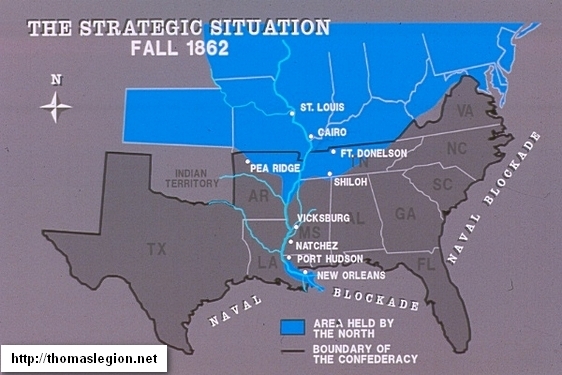
Leaders of the Union and Confederacy realized the absolute strategic importance of controlling Vicksburg. Jefferson Davis stated "Vicksburg is the nail head that holds the South's two halves together." Abraham Lincoln referred to Vicksburg as the "key" and "the war can never be brought to a close until that key is in our pocket."
Vicksburg was very well protected, the city sat high on the bluffs overlooking the River. Vicksburg lies on the highest spot along the Mississippi River south of Memphis to the Gulf of Mexico. Any ships going along the river would be sitting ducks to the large battery of Confederate cannon placed on the bluffs.


The entire campaign lasted from December 1862 to July 1863. The commander of the Union troops in the area was Ulysses S. Grant. The Confederates in Vicksburg were led by John C. Pemberton, who had his headquarters in one of the mansions in town. The home is still standing.

Grant's stubborn determination served him well in the long campaign and siege. He led a number of overland advances to Vicksburg from the north. Each one failed, as is armies met stern resistance from Conferderates, and his troops got bogged down in the marshes and rivers north of town.
Grant had a bold and risky idea. The land south of Vicksburg was much more effective to launch an attack. He would lead his troops on the Arkansas side of the Mississippi River (which was controlled by the Union) into Louisiana, cross the Mississippi River south of Vicksburg and then attack and lay siege to the city from the south and east. This plan depended on being supplied with goods that would have to be transported by boat on the Mississippi river. The supplies would have to pass by the battery along the high bluffs of Vicksburg. Admiral David Porter was charged to keep the supplies afloat to provide Grant's troops. On April 16, 1863, on a clear night with no moon, Porter made the dangerous crossing. Although every effort was made to minimize noise and lights, the ships were espied by the Confederate troops. A large volley followed, with Union gunboats trying their best to counter the attack. The fleet survived and supplied the troops, allowing the Union to surround the city and lay siege.
The siege lasted for three months, from April to July 1863. The Confederates were able to repel and hold off the Union troops after a number of devastating attacks, but Grant was relentless. After thousands of losses on both sides, Pemberton realized he was vastly outnumbered, his troops and the town were starving and that no Confederate help was arriving from the East. On July 4, 1863 (the day after the Confederate defeat at Gettysburg), Pemberton surrendered to Grant. This was a costly loss for the South. The Confederacy was split in two, the Union controlled the entire Mississippi River, Vicksburg was a launching point for Sherman's siege of Atlanta and March to the Sea, and Grant's victories led to his being appointed general in chief of all Union armies.
Today, you can visit the battlefield where the siege took place. There is a great museum and you can have a guide join you in your car to give you a detailed tour of the site.

 |
| portrait of CSA general Pemberton and his sword |
 |
| cannonball stuck in a tree trunk |

Reconstruction of the barricades and revetments set up by the armies.


The monument to the Illinois soldiers.


Statue of John Alexander Logan. Logan was a U.S. Senator from Illinois who became general and commander of the 3rd Division of XVII Corps. At this spot he lead a fierce attack that blew a hole in the Confederate redoubt. The break in the Confederate lines was only temporary, a fierce counterattack repelled the Union troops back to their lines. Later, Logan's troops were the first to enter the city of Vicksburg after the Confederate surrender. After the war, Logan returned to the Senate and was the Republican Party nominee for Vice President in the 1884 election. He and Presidential candidate James G. Blaine lost to Grover Cleveland.

The Illinois memorial was dedicated in 1906. Inside, the names of all 36,325 Illinois soldiers who participated in the Vicksburg campaign are emblazoned upon its walls.


This Monument to African-American troops at Vicksburg was dedicated in 2004. By the end of the war, nearly 200,000 African Americans had joined the Union Army and Navy. Vicksburg was the scene of some of the earliest combat experienced by recently freed slaves who joined the Union Army. They fought bravely and, although outnumbered, fought off Confederate troops at the Battle of Port Hudson and Milliken's Bend (both of which were just outside Vicksburg). Milliken's Bend was a particularly important battle. Milliken's Bend (in Louisiana) was a site where Union supplies were defended by African-American troops, who were largely untrained and had inferior weaponry. The Confederates were convinced they would fall like dominoes and attacked to take out the vital supplies. Although outnumbered, the African-American division fought off the Confederates strikes. Thankfully, some gunboats arrived and forced the Confederates to retreat. It was a costly victory, Confederate losses were 185, but the African-Americans that fell in the battle numbered 652.

Imposing statue of General Grant on horseback.


The memorial to the Confederate troops from Texas who fought at Vicksburg was dedicated in 1961.
While driving along the Park Road, make sure to stop at the incredible display of the USS Cairo. The USS Cairo was one of the first ironclad warships built by the Union at the beginning of the Civil War. An ironclad is a steam propelled warship protected by iron or steel armor plates. The armor made them far superior than their predecessors, which were made out of wood. On December 12, 1862, while clearing mines from the Yazoo River outside of Vicksburg, the USS Cairo was struck by a torpedo or naval mine launched by Confederate volunteers that were hiding on the river bank. It took 12 minutes for the USS Cairo to sink, and there were no casualties.
The wreck was discovered in 1956. Artifacts, and the ship itself were well preserved by the Yazoo River mud, and the boat (which is partially restored) is on display at the Park. It's a very unique site and one of the last surviving ironclad warships in the entire world.


Be sure to stop at the Vicksburg National Cemetery, which holds the remains of 17,000 Civil War soldiers, making it the largest national cemetery in the country.


The sobering experience is something that every American should visit and learn about. It's a history that should never be forgotten. Although Gettysburg is the much more famous battle, Vicksburg was arguably more important to the ultimate Union victory. For more info: https://www.nps.gov/vick/index.htm


