Sunday, March 10, 2019

Pinnacles National Park

Visited: May 2018
Nearby town: Salinas, CA

Hidden away in a rather remote area of central California is one of the state's lesser known gems, Pinnacles National Park. This relatively small park is one of our newest ones, created in 2013 (however, it had been a national monument since 1908).

The park's towering and somewhat eerie pinnacles, crags, and spires were created by plate tectonics, earthquakes, and volcanic activity. The park is relatively compact, but bear in mind there is no through road in the park boundaries that connects the East and West Entrances (you'll have to take about an hour and a half loop either from the north or south to hit both entrances). Because of that you may want to spend at least two days in the park, one for the west entrance and one for the east entrance.

We started our journey at the East Entrance of the Park, and did the incredible Bear Gulch/High Peaks/Condor Gulch loop trail. This combination was a great hike, pretty long (about 6.7 miles), but well worth it. And it showcases pretty much all there is to see here. If you don't have enough time you can shorten it by just doing the Bear Gulch section, or just the High Peaks section, etc.

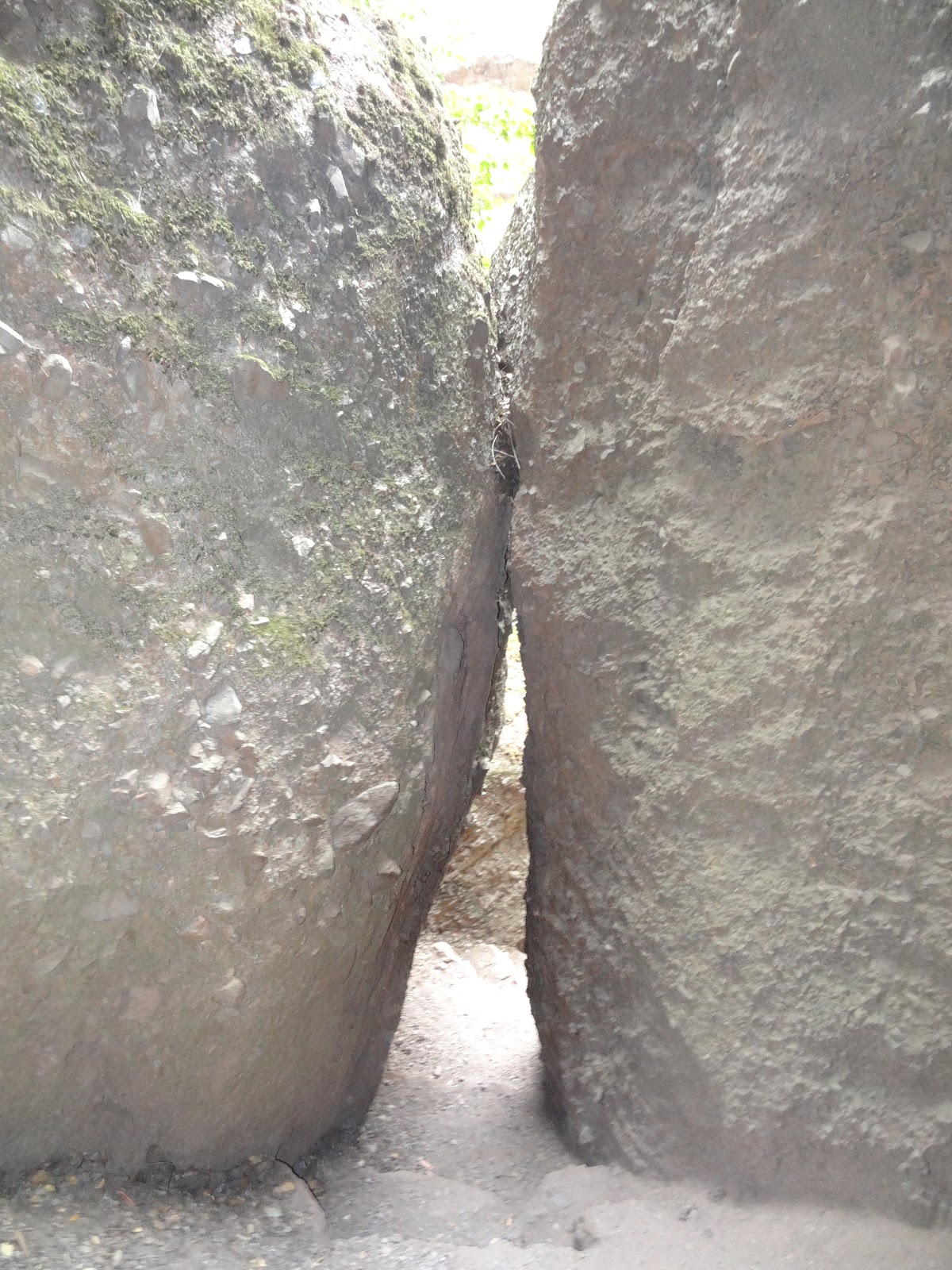
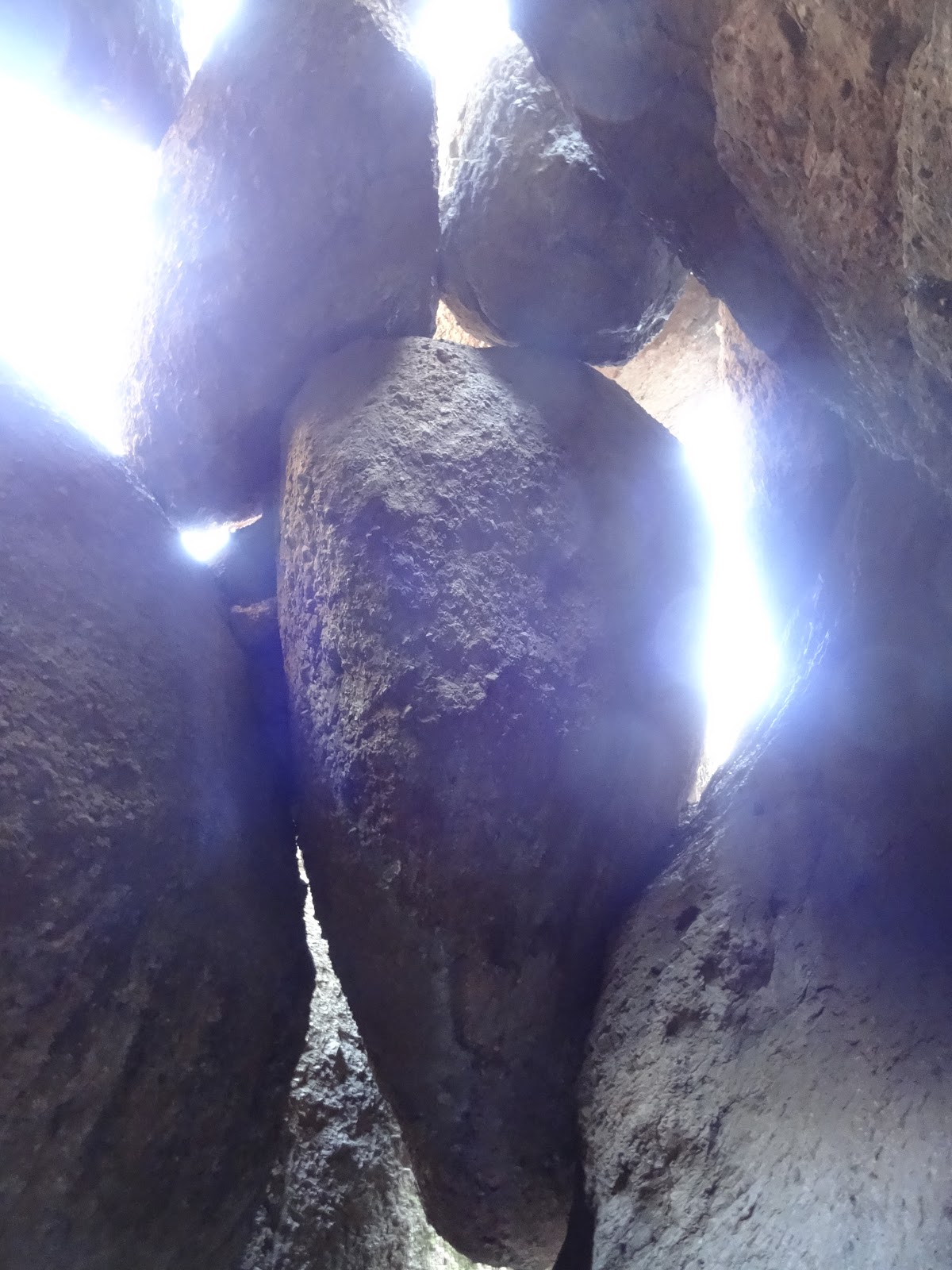
The trail first heads to the Bear Gulch reservoir. This hike is very cool because you go through a cave. It's a talus cave, which means it is formed by openings in large boulders piled up on mountain slopes. Therefore, it is not entirely enclosed, but it would be a good idea to have a flashlight for the particularly dark sections.


a rather tight squeeze


Going through the talus cave was very enjoyable. As you can probably tell, Pinnacles is an outstanding destination for rock climbers. We did see a number of climbers throughout the park. Eventually, you emerge from the talus cave and get to the Bear Gulch reservoir.


At this point, the trail heads up to the top of the craggy peaks, this is the High Peaks section.


Just a heads up as you go along the High Peaks portion. Once you get to the top of the mountain, there are some narrow ledges and steps along the trail. There are railings to help you along. It's a little intense, but not too crazy.


As you go along the High Peaks section, look toward the skies for condors. You'll also see lots of turkey vultures. Here's how to spot the difference, the bottom of the wings of a turkey vulture are brown. The bottom of California Condor wings have a white patch along the top part of the wings, like this:
Along the trail, we were treated to a rare surprise. We saw a juvenile condor and two adult condors right along the trail. We we're right next to them! It was awesome.


Condors have been a huge success story in the park. In 1987, these large rather majestic birds actually went extinct in the wild, and only 27 individuals in captivity. They have since been re-introduced in northern Arizona and central California, including the park boundaries. Pinnacles National Park now manages 86 wild condors within the boundaries (notice the numbered tag on the adult condors). As of 2017, there are now 463 condors living either in the wild or in captivity. Seeing these condors in the wild up close and personal was a highlight of our visit.

The next day we headed to the West Entrance and did the Balconies Loop Hike. This hike was good (although not as cool as the High Peaks loop), and the cave section is a little more difficult than the Bear Gulch cave, some scrambling and bouldering required. Nothing too intense.


 Although Pinnacles is not as well-known as other California national parks (such as Yosemite, Sequoia, Death Valley, etc.), it is well worth a visit. Pinnacles exceeded our expectations big time. For more info: https://www.nps.gov/pinn/index.htm

Wednesday, February 20, 2019

John Day Fossil Beds National Monument

Visited: Sept 2014
Nearby town: John Day, OR

This park in Central Oregon holds a vast collection of plant and mammal fossils ranging from the Eocene to the late Miocene Epoch (45 million years ago - 5 million years ago). The park contains some of the best preserved fossils found from this time period. John Day Fossil Beds is made up of three distinct units: (1) Sheep Rock Unit - this is the most developed and most visited section (2) Painted Hills Unit and (3) Clamo Unit. All of these units are quite a distance from each other, but could be visited all in one day.

We only stopped at the Sheep Rock Unit, just off the main highway west of the little town of John Day in Grant County. Our first stop was the excellent Visitor Center, home of the Thomas Condon Museum. Spend some time here to observe the fossils and learn about the area's history.
Bear in mind that the fossils here are from an age after the dinosaurs went extinct. So don't expect any dinosaur fossils, but there are lots of prehistoric mammals and plants to see.

After you're done going through the museum head north for a few miles to Blue Basin area and take a hike through the exquisite badlands. It's only about a 1.5 mile hike, you can just take Island in Time Trail, or combine it with the Blue Basin Overlook Trail for the full 3 mile hike.


Another great stop is the James Cant Ranch. The Cant family owned and operated a ranch along the John Day River from 1910 - 1975. The NPS purchased the ranch from the Cant family and have turned it into a lovely museum. Tour the Ranch House and Barn and learn about ranching and farming life in the early 20th century. It's well worth a visit.


Bonus stop: About two hours west of John Day is the excellent Smith Rock State Park just north of Bend. Although not part of our National Park series, this is a great place to stop to take a stroll through the beautiful area. If you're up for it, it's also a great place to get in some rock climbing, or just observe it safely from the ground.


This part of central Oregon is a beautiful drive and John Day Fossil Beds National Monument makes for a pleasant and informative stop for an hour or two or half a day trip. More info here: https://www.nps.gov/joda/index.htm

Sunday, February 10, 2019

Wind Cave National Park

Visited: March 2018
Nearby town: Hot Springs, SD; Nearby city: Rapid City, SD

Southwestern South Dakota is a bounty of natural beauty and historical sites. Just south of Mt. Rushmore lies Wind Cave National Park. If you find yourself visiting Mt. Rushmore or Badlands National Park, make a stop at Wind Cave. Another nearby cave is Jewel Cave National Monument. Both are worth a visit, but if you are strapped for time, Jewel Cave is honestly the prettier cave and I would make that your choice. With that said, Wind Cave is a great place to visit.

The morning of our visit, there was a nice blanket of snow to greet us. There's not too much to do above ground at this national park (there's a couple of hiking trails that wind their way through the rolling hills), we were lucky to spot some bison.


Make sure to stop at the Visitor Center first. Tickets for three of the tours offered can only be purchased at the Visitor Center on a first-come first-served basis. (1) Garden of Eden Tour - this is the easiest hike and best for families, it only lasts an hour and is accessed by an elevator (2) Natural Entrance Tour - this is probably the best tour to take to see what Wind Cave as to offer - and don't worry, you don't actually have to climb through the incredibly small natural entrance on this tour and (3) Fairgrounds Tour - lasts about 1 hour and half.

Two tours require advance reservations. (1) Candlelight Tour - this tour is done with lanterns and (2) Wild Cave Tour - this long, strenuous tour requires lots of crawling and squirming. Be prepared.

Go through all the exhibits and learn about the cave and some of the things you will see.
Example of the boxwork formation that is almost entirely unique to Wind Cave


I loved the awkward pose of the mannequin. 😃

We took the Natural Entrance Tour. The Lakota Sioux considered the cave sacred and referred to it as a "hole that breathes cool air." According to legend, the hole was where the first bison emerged to roam the prairies. The "wind" coming from the natural opening is caused by air pressure. When the pressure outside the cave is greater than pressure inside, air flows into the cave. When the pressure is greater inside the cave, gusts of air blow out.

The first whites discovered the cave in 1881, and as the story goes, explorer Tom Bingham leaned over the hole when a gust of wind blew the hat off its head and it disappeared into the chasm. Wind Cave National Park was established in 1903. 
That little hole is the Natural Entrance. If you wanted to tour the cave before the elevators were put in, this is how you got into the cave. A very tight fit!


Our tour guide standing next to the Natural Entrance. Once inside, you'll realize Wind Cave is almost completely dry. You won't find hardly any of the normal cave features like flowstone, stalagmites, or stalactites. The most prominent feature here is called "boxwork" Boxwork is formed by a mineral calcite that exists in the cracks of the cave walls and rocks. As the rock erodes away, the exposed fin of the calcite remains, and forms a box-like or honeycomb pattern. The name "boxwork" comes from early explorers who thought the calcite formations looked like a post box. 95% of the known boxwork formation in the world is found in Wind Cave.


I'll admit that Wind Cave is not the most incredible or beautiful cave I've been in, but it is unique and well worth a tour. For more info: https://www.nps.gov/wica/index.htm