Saturday, March 12, 2022

Independence National Historical Park


Visited: Sept 2019
Nearby city: Philadelphia, PA

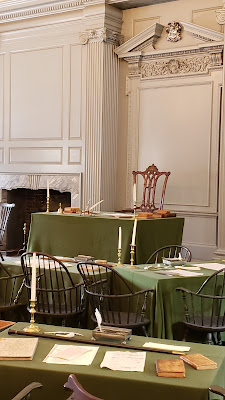
"I have often, in the course of the session, looked at that sun behind the President without being able to tell whether it was rising or setting. But now at length I have the happiness to know it is a rising and not a setting sun."
-Benjamin Franklin, September 17, 1787, as the Constitution was being signed, commenting about the carved sun on the back of the chair used by the President of the Convention

Philly. The City of Brotherly Love. The Athens of America. Philadelphia, Pennsylvania is the home of many of America's firsts: library, hospital, medical school. Philadelphia also served as the nation's first capital. Today, certain parts of downtown are protected as Independence National Historical Park. It preserves many historically significant sites that were critical to America's independence from Britain and the formation of the federal government.

The centerpiece of the Park is Independence Hall.
This Georgian-style red brick building served as the seat of State government and was completed in 1753. 

Independence Hall was the location of two momentous events in America's early history: (1) signing of the Declaration of Independence in 1776; and (2) formation of the US Constitution in 1787.

The Hall's steeple was also the original home of the famed Liberty Bell. The iconic bell was commissioned in 1752 and was cast with the lettering "Proclaim LIBERTY throughout all the land unto all the inhabitants thereof." The bell was ceremoniously rung to mark the reading of the Declaration of Independence, for many years the story was told that the bell was rung on July 4, 1776 - but it's more likely that it was rung at the public reading a few days later, on July 8. The bell developed its distinctive crack sometime in the early 1800s. The bell would be taken around the country for people to see, but as more cracking and damage occurred, its last nationwide tour was 1915. The bell's permanent resting place is now at the Park museum/visitor center across the street from Independence Hall. The bell has become a symbol of not only the city, but the nation as a whole.


The Hall is open to the public, but you must tour it with a guide. Head to the visitor's center early in the day and get your ticket. 

The Hall has two large rooms, one in each wing: (1) the Assembly Room; and (2) the Supreme Court Room. Independence Hall served as the principal meeting place for the Second Continental Congress from 1775-1783. The Continental Congress was a body of representatives from each of the thirteen colonies. In June 1775, the Continental Congress nominated George Washington as commander-in-chief of the Continental Army. On July 4, 1776, the Congress approved the Declaration of Independence. The declaration, primarily drafted by Thomas Jefferson, officially declared the colonies independent from Great Britain, listed the grievances against British authority and justifications for revolution, and outlined the natural rights, ideals and guidelines of the new government that the colonies intended to form.

"We hold these truths to be self-evident, that all men are created equal, that they are endowed by their Creator with certain unalienable Rights, that among these are Life, liberty, and the Pursuit of Happiness. That to secure these rights, Governments are instituted among Men, deriving their just powers from the consent of the governed..."
-from the Preamble of the Declaration of Independence


After the hostilities of the American Revolution ended and Britain recognized the colonies' independence in the Treaty of Paris in 1783, the new government struggled enormously. The first governing framework of the nation, the Articles of Confederation, proved inadequate in facilitating trade and commerce between the new states, and also between the states and foreign powers. The economic situation was dire. It led to populist uprisings such as Shays' Rebellion in Massachusetts.

Delegates from the respective states met at Independence Hall in the spring/summer of 1787 to discuss ways to amend and improve the Articles of Confederation to deal with these problems. As the debate at the Convention raged on, the delegates came up with essentially an entirely new constitution to replace the Articles. James Madison of Virginia was instrumental in the drafting and formation of this Constitution. The Constitution created a strong federal government, made up of three branches - a (1) bicameral legislature, (2) executive, and (3) judicial. Each branch had separate powers, and served as a check on the other branches. The delegates realized that the Constitution was a result of compromise and was not perfect. Therefore, a mechanism was developed in the document itself to amend it. 

At the closing of the Convention, the most senior delegate, 81-year old Benjamin Franklin, commented:

"I confess that there are several parts of this constitution which I do not at present approve, but I am not sure I shall never approve them: for having lived long, I have experienced many instances of being obliged by better information, or fuller consideration, to change opinions even on important subjects, which I once thought right, but found to be otherwise. It is therefore that the older I grow, the more apt I am to doubt my own judgment, and to pay more respect to the judgment of others. ... 

I doubt too whether any other Convention we can obtain, may be able to make a better Constitution. For when you assemble a number of men to have the advantage of their joint wisdom, you inevitably assemble with those men, all their prejudices, their errors of opinion, their local interests, and their selfish views. From such an assembly can a perfect production be expected? It therefore astonishes me, Sir, to find this system approaching so near to perfection as it does."

The Convention was completed on September 17, 1787, and then the Constitution was ratified by the states and took effect on March 4, 1789. By 1789, the capital had moved to New York City, and that is where the first Congress met. George Washington was elected as the first President. The Congress then moved to Philadelphia in 1790, and then finally to it's current home, the newly-built capital of Washington DC in 1800.


Once your tour is complete, make sure to head to some of the other areas of the Park, which are all within walking distance from Independence Hall. Sites include: (1) Carpenters' Hall - the meeting place for the First Continental Congress in 1774; (2) Dolley Todd House - home of the future First Lady, Dolley Madison; (3) Free Quaker Meetinghouse; (4) Old City Hall - first home of the US Supreme Court; (5) Second Bank of the United States; (6) Benjamin Franklin's grave; and many other sites, buildings, and museums.
cemetary where Benjamin Franklin is buried


south side of Independence Hall


Dolley Todd house

Carpenters' Hall

Benjamin Franklin's grave

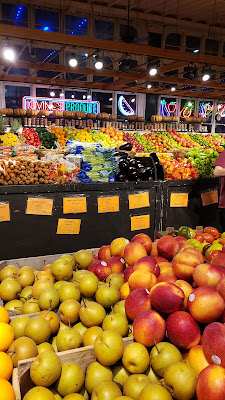
There are also lots of sites to see around the beautiful city of Philadelphia. Great architecture. We stopped by Reading Terminal Market, walked around downtown, the "Rocky" steps, and the Philadelphia Museum of Art.


Reading Terminal Market


Philadelphia City Hall


City of Brotherly Love


Rodin Museum - contains large collection of works by the great sculptor, Auguste Rodin (1840-1917)


Philadelphia Museum of Art, these steps were immortalized in the 1976 film "Rocky"


We enjoyed our time in Philadelphia. For more info: https://www.nps.gov/inde/index.htm

Sunday, February 27, 2022

Valley Forge National Historical Park

Visited: Sept 2019
Nearby city: Philadelphia, PA

"To see men without clothes to cover their nakedness, without blankets to lie on, without shoes, by which their marches might be traced by blood from their feet, and almost as often without provisions as with them, marching through the frost and snow, and at Christmas taking up their winter-quarters within a day's march of the enemy, without a horse or hut to cover them, till they could be built, and submitting to it without a murmur, is a proof of patience and obedience, which in my opinion can scarce be paralleled."
-George Washington, in a letter to John Banister dated April 21, 1778

The American Revolution had been raging for nearly two-and-a-half years, and by September 1777, prospects for a Patriot victory were looking rather grim. The Marquis de Lafayette had joined General Washington and the Continental Army a few months earlier and hoped that he could successfully persuade the French government to ally with the newly-formed nation against the British. 

British General Sir William Howe, who had long occupied New York City, moved his army to attack and occupy the town of Philadelphia, where the Second Continental Congress had been meeting and running affairs for the upstart nation. Howe's forces engaged Washington's forces at the Battle of Brandywine on September 11, 1777. Washington put up stiff resistance, but Howe broke through the line and the Continental Army was forced to retreat. The Marquis de Lafayette was badly wounded, but survived. Howe would move in towards Philadelphia and occupied the city a few days later. Now, the British Army controlled and occupied yet another important colonial city. 

The Second Continental Congress had evacuated the city before Howe's invasion, and relocated to the town of York, about 100 miles west of Philadelphia. Washington decided to position his army between the occupied town of Philadelphia and the town of York. The selected place was a high, flat plain south of the Schuykill River known as Valley Forge. There they would encamp during the winter of 1777-1778.

As the Continental Army began to fortify the position, they got some incredibly good news. British General John Burgoyne's army, who had advanced from British Canada south towards New York City, had been soundly defeated by Patriot General Horatio Gates at the Battle of Saratoga in upstate New York. Curiously, Howe decided not to send troops from New York City or Philadelphia to reinforce Burgoyne. The British defeat at Saratoga was so decisive, that the French government decided to join with the colonies, officially support American indepedence, and declared war on the mighty British Empire. This alliance would provide crucial military support and supplies to the American army, and would force the British to fight a two-front war, one in the colonies against America and one against the French in the West Indies and Europe.

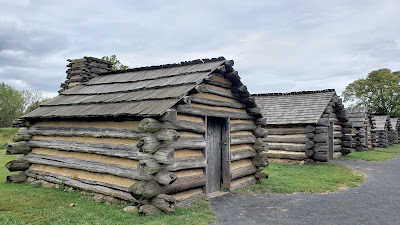
Now, buoyed by the news of this great victory, Washington and the 12,000-strong Continental Army just needed to bunker down and get through the winter of 1777-1778 at Valley Forge. The first order of business was to construct a large-scale living quarters. The soldiers themselves constructed approximately 1,500 log huts. They weren't much, in fact, Marquis de Lafayette described them in a letter to his wife as "small barracks, which are scarcely more cheerful than dungeons." These barracks have been reconstructed at the National Park site. You can learn all about living conditions of the soldiers in these quarters.


The Continental Army was in desparate need of supplies, Washington worked hard to secure these funds from the Second Continental Congress, but it was not easy. The army also had to deal with a smallpox outbreak and inclement weather conditions. The Valley Forge encampment lasted six months, from December 19, 1777 to June 19, 1778. During that time, about 1,700-2,000 (around 15%) of the soldiers stationed there died from starvation, the winter cold, and disease.

Although it was a time of great suffering for the army, it was also a time of training and rejuvenation. A Prussian military officer, Baron Friedrich von Steuben, volunteered to lead the training of the Continental Army, and instructed them in the essentials of military drills, tactics, and discipline. This training would prove invaluable to the later successes of the Continental Army. The shared hardship of the officers and soldiers in the army helped build the espirit de corps that eventually lead to American victory. In many ways, Valley Forge was a "refiner's fire" for the Continetnal Army and a turning point for the American revolution.

Today, Valley Forge National Historical Park, created first as a state park in 1893 and later as a National Park in 1976, preserves and protects these 3,500 acres of the winter encampment. The capstone of the park is the National Memorial Arch, built in 1917, that honors the sacrifice of the troops that served and died here. It is a somber place.


Start your visit at the Visitor's Center, which has a lot of exhibits and information. Then take the tour road, that will take you throughout the Park, stopping at all the key sites and monuments. There's also some nice biking and hiking trails, the surrounding landscape is beautiful.

Stop by the statue of General "Mad" Anthony Wayne. Wayne had served with distinction during the French and Indian War. Washington heavily relied on Wayne's leadership at Valley Forge. Wayne would later lead a daring success against the British in 1779 at the Battle of Stony Point in New York.


Another key attraction is Washington's headquarters. The home was built in 1770 by Isaac Potts, a Quaker who owned and operated a nearby grist mill. The home served as Washington's headquarters during the Valley Forge encampment. The home has been partially restored, and stop by to learn about Washington's day-to-day work and military planning.


If visiting Philadelphia area, make sure to make the journey to visit this incredible historical site. More info here: https://www.nps.gov/vafo/index.htm