Friday, May 12, 2023

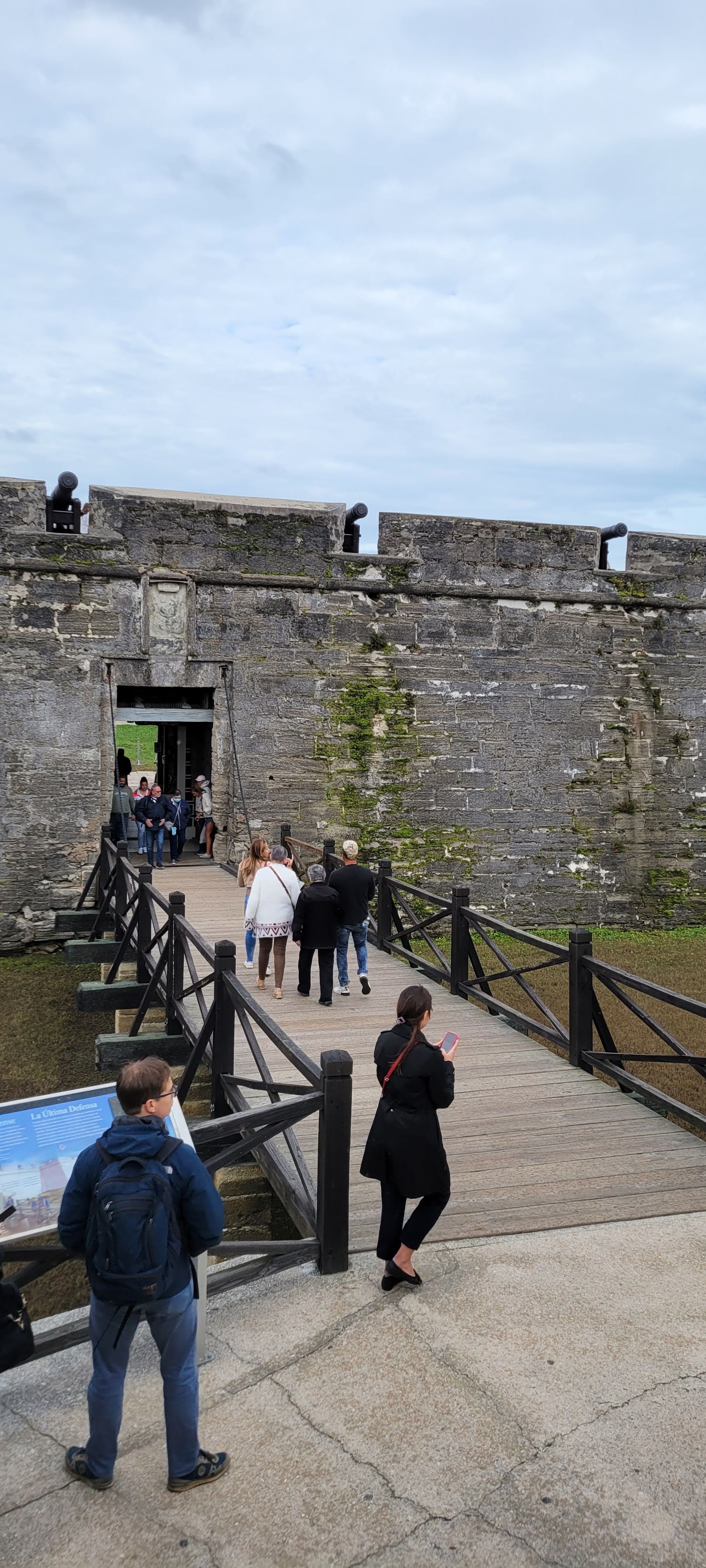
Castillo de San Marcos National Monument

 
Visited: Nov 2022
Nearby city: St. Augustine, FL

Castillo de San Marcos (St. Mark's Castle) is the oldest masonry fort in the country. The fort is located in the town of St. Augustine, Florida. Founded in 1565, St. Augustine is the oldest continuously inhabited European settlement in what is now the United States.  The town was founded by the Spanish conquistador Pedro Menendez de Aviles and served as the capital of Spanish Florida for over 200 years. 

St. Augustine was sacked and nearly destroyed by English privateer Robert Searle in 1668. After the raid, Governor Francisco de la Guerra y de la Vega ordered that a mason fort be constructed in order to protect the city. Construction began in 1672 and was eventually completed in 1695. The fort sits on the coast where the Matanzas River empties into the Atlantic Ocean. This was a prime spot to guard against attacks by pirates.

In 1670, English colonists founded Charleston (in present-day South Carolina). Charleston was only a two day's sail from St. Augustine and conflict over land claims between the Spanish Empire and the British Empire inevitably broke out. Additionally, slaves from the Carolina Colony would escape to St. Augustine, where the Spanish authorities agreed to free (and employ) them if they converted to Catholicism. In 1702, the governor of Carolina Colony, James Moore, led an expedition in an attempt to conquer and occupy St. Augustine. Moore's army laid seige to the town for over two months, but failed to capture the fort. The fort's thick walls stood strong against the English cannon and Moore's army retreated back to Carolina. The fort again defended the town in 1740, when the founder and Governor of the Colony of Georgia, James Oglethorpe, led an unsuccessful attempt to conquer the city.

At the conclusion of the Seven Years' War and the signing of the Treaty of Paris (1763), Spain ceded Spanish Florida to Britain in exchange for Britain returning the ports of Havana (in Cuba) and Manila (in the Philippines) to Spain. The fort was under British control for approximately twenty years. But then under the terms of the Treaty of Paris (1783), which ended the American Revolution, Britain returned Florida to the Spanish Empire.

The Spanish Empire and the newly-formed United States of America would quibble over the boundary between the two countries over the years. However, the gradual decline of the Spanish Empire in the early 19th century and violent revolutions in Mexico and its other colonies in Central and South America, led Spanish authorities to agree to cede Florida to the USA as terms of the Adams-Onis Treaty in 1821.

The fort (renamed by the Americans as Fort Marion) served as a military installation until 1933 - except for a brief period when the Union Army abandoned the fort early in the Civil War. In 1933, the fort was transferred to the National Park Service.

When we visited, we were lucky to observe a cannon firing demonstration. It was really cool.


Tara with a cannoneer in traditional uniform

Take a tour of the building, there are lots of exhibits to learn all about life at the fort. There's also lots of antique cannons on display.


The fortress walls were built with coquina (Spanish for "small shells"). Coquina consists of ancient shells that have bonded together to form a sedimentary rock similar to limestone. These strong walls were nearly imprenetrable against cannon attack. Instead of shattering, the walls would compress and absorb the shot. Cannonballs would either bounce off, or only sink in the walls a few inches. This unique material became known as the "rock that saved St. Augustine." 


the emblem flying over the fort is the historical flag of the Spanish Empire. 
Known as the "Cross of Burgundy"


the shape of the Castillo de San Marcos is a "star fort"


the city crest of St. Augustine

close up of the coquina walls. See all the shells? 


The moat surrounding the fort was usually kept dry. But could be flooded with about a foot of water in case of an attack by land.


this structure is a furnace to make "heated shot"
Heating a cannonball before firing was used to set ships and buildings ablaze.


St. Augustine is an interesting, unique town full of historical buildings. We explored the town. St. Augustine is famous for its Christmas displays.


The historic Hotel Alcazar was built by industrialist Henry Flagler in 1887. Flagler was co-founder of Standard Oil with John D. Rockefeller. Flagler also built the Florida East Coast Railway, which was instrumental in the development of Florida to the vacation and retirement destination that it is today.

Hotel Alcazar now houses the Lightner Museum. 

statue of the founder of St. Augustine, Pedro Menendez de Aviles


beautiful Flagler College, a private liberal arts college. 
The main building on campus is the former Ponce de Leon Hotel, built in 1888 by Flagler.


inside the historic Ponce de Leon hotel


the historic city wall


the Atlantic Ocean

We had a great time in the beautiful historic town of St. Augustine.

Saturday, April 29, 2023

Andersonville National Historic Site


Visited: Nov 2022
Nearby town: Americus, GA; Andersonville, GA

"As we entered the place, a spectacle met our eyes that almost froze our blood with horror, and made our hearts fail within us. Before us were forms that had once been active and erect -- stalwart men, now nothing more than mere skeletons, covered with filth and vermin.

Many of our men, in the heat and intensity of their feeling, exclaimed with earnestness 'Can this be Hell? God Protect us!' and all thought that he alone could bring them out alive from so terrible a place. In the center of the whole was a swamp, occupying about three or four acres of the narrowed limits, and a part of this marshy place had been used by the prisoners as a sink, and excrement covered the ground, the scent arising from which was suffocating. The ground allotted to our ninety was near the edge of this plague-spot, and how we were to live through the warm summer weather in the midst of such fearful surroundings, was more than we cared to think of just then."

-Sgt. Maj. Robert H. Kellogg of the 16th Regiment Connecticut Volunteers, describing his entry to Andersonville Prison on May 2, 1864

The hell described by that Union soldier was found at a POW camp in southwestern Georgia. The Confederacy established the prison in February 1864, towards the end of the Civil War.

Andersonville Prison (also known as Camp Sumter) housed over 45,000 Union soldiers captured as prisoners of war. The conditions at the camp were deplorable. In its fourteen months of operation, nearly 13,000 soldiers at the prison died. Most died of scurvy, diarrhea, and dysentery.

The prison grounds are now preserved as Andersonville National Historic Site. Also at the site is the Andersonville National Cemetery and the National Prisoner of War Museum. It is a very sobering visit.

The Museum honors all American soldiers who were prisoners of war throughout the country's history. There are many interactive exhibits, artifacts, and letters written by soldiers detailing their experiences as prisoners of war. Lots of information about the history of Andersonville as well.


handmade crystal radio receivers built by POWs during WWII. Made out of smuggled goods, the radios allowed soldiers to hear something other than enemy propoganda broadcasts.


these sculptures memorialize US soldiers taken as prisoners of war


Andersonville Prison covered 26.5 acres enclosed by a 15-foot high stockade. When the prison first opened, it housed about 7,000 POWs, but that number quickly swelled to 30,000 by July 1864. After a company of African-American Union POWs were sold into slavery by Confederate officials instead of being exchanged for Confederate POWs held by the Union, General Grant and the Union Army halted all prisoner exchanges. This policy contributed to the growth of the prisoner population at Andersonville and other POW camps in the south. Furthermore, the Confederate government was in such dire economic straits, that they could not afford to establish additonal prisons to alleviate overcrowding. Neither could they afford to provide adequate food to the prisoners. Andersonville became overcrowded to four times its capacity, and had inadequate water supply, inadequate food, and unsanitary conditions. The Vitamin C deficiency due to lack of fresh fruit and vegetables led to scurvy, dysentery, typhoid fever, and the high mortality rate among the prisoners.

Reconstruction of the stockade wall. I'm standing next to a fence known as the "dead line." This fence was placed 19 ft inside the stockade wall. It demarcated a no man's land. If a prisoner crossed the "dead line" they were shot without warning by a sentry in the guard tower (seen here on the opposite side of the stockade wall). It is believed that this is where the modern term "deadline" comes from.


Each prisoner had a "personal" space of about 5 feet by 6 feet 


The camp's only water source was a small offshoot of a creek known as Stockade Branch that ran through the middle of the camp. The creek also served as the bathroom, and thus, was highly contaminated. This also led to much disease and sickness. One night in August 1864, during a violent thunderstorm, a bolt of lightning struck the grounds of the camp and unearthed a spring that had likely been covered up when the prison was built. The prisoners now had a fresh water source. This fortuitous incident was considered a miracle and the spring was dubbed "Providence Spring." In 1901, the survivors of Andersonville placed a monument at the site of this miraculous spring.

Providence Spring


Andersonville Prison was liberated by the Union Army in May 1865, about one month after General Lee surrendered at Appomattox. 

The prison's commander, Henry Wirz, was tried by a military tribunal on charges of war crimes. Wirz was born in Switzerland and immigrated to the US at the age of 25. Wirz lived in Massachusetts, then Kentucky, and ultimately settled in Louisiana where he worked as an overseer of a plantation and practiced homeopathic medicine. At the outbreak of the Civil War, Wirz enlisted as a private in Company A of the 4th Battalion Louisana Infantry of the Confederate Army. He rose through the ranks and was appointed to the post of commandant at Camp Sumter (Andersonville Prison).

Entered into evidence at the trial was an 1864 letter written by a Confederate surgeon, Dr. James Jones, who had been sent to investigate conditions at the prison. Jones reported the appalling conditions to Confederate authorities. In the one hour that Jones spent at the camp, he reported that he vomitted twice and contracted influenza. The tribunal heard from 12 witnesses, who testified that they witnessed Wirz physically stomping and kicking a prisoner, confining prisoners in stocks, beating a prisoner with a revolver, chaining prisoners together, ordering guards to fire on prisoners, having dogs attack a prisoner, and personally shooting and killing three prisoners. The tribunal also heard from 145 witnesses who did not observe Wirz kill any prisoners. Wirz's defense was that he had pleaded with Confederate authorities in an attempt to get more food and better conditions for the prisoners, but that his requests were ignored or denied. Wirz was reviled in the press as "The Demon of Andersonville." Wirz's defense was to no avail, he was found guilty. As punishment, Wirz was executed by hanging on November 10, 1865, one of only two men who were tried, convicted, and executed for war crimes during the Civil War.

Wirz's trial and sentencing has been a source of controversy. Some historians consider Wirz a scapegoat, and that the fault for the deplorable conditions at Andersonville rests more with the Confederate authorities who refused to provide necessary funds and supplies to house and feed the POWs.

Make sure to stop at the National Cemetery. It contains 13,714 graves, including 921 which are marked as unknown. 


Andersonville National Historic Site is hallowed ground that every American should visit.