Sunday, April 11, 2021

Grand Portage National Monument

 
Visited: Aug 2018
Nearby town: Grand Portage, MN

Way up north in Minnesota, along the shore of Lake Superior and near the border of Ontario, lied one of the most important fur trade centers in North America. As beaver hats and other accessories became more and more popular in Europe in the 1700s and 1800s, the fur trade boomed and proved very profitable for the British Empire. Voyageurs (French term for "explorer") would travel from Montreal all the way down the St. Lawrence River, through the Great Lakes, and then to the vast hinterlands of the Canadian North and trap a variety of animals (beaver, otter, lynx, marten, etc.). They would then transport their furs back to Montreal and then onto the US East Coast and/or Europe.

The Voyaguers would make their long journey by canoe. Occassionally, the Voyageurs would come across a rough, impassable part of the rivers they were traversing (rapids, waterfalls, etc.) and then would have to carry (or "portage") their canoes and cargo over land. Most of these portages would be relatively short. However, once the Voyageurs reached the western end of Lake Superior, they would undergo a "Grand Portage" (an 8.5 mile footpath) to bypass the rapids and waterfalls of the Pigeon River as it empties into Lake Superior.

At this Grand Portage, the British Empire would eventually construct a Great Hall at the spot, where Voyageurs would rest, recuperate, trade, and interact socially. Today, the NPS has reconstructed the Great Hall that serves as a museum to learn about the Voyageurs and this vital trade route.

To learn more about the Voyageurs, please read my blog post about our visit to Voyageurs National Park for more info: https://paulnationalparks.blogspot.com/2019/08/voyageurs-national-park.html     

Your first stop should be the Great Hall. Every August, the park holds a big rendezvous, and you can visit with lots of reenactors and people in period costume, etc. It was a lot of fun. It's a great museum.


voyageurs would travel on the Great Lakes on these gigantic canoes.

the stockade surrounding the fort.


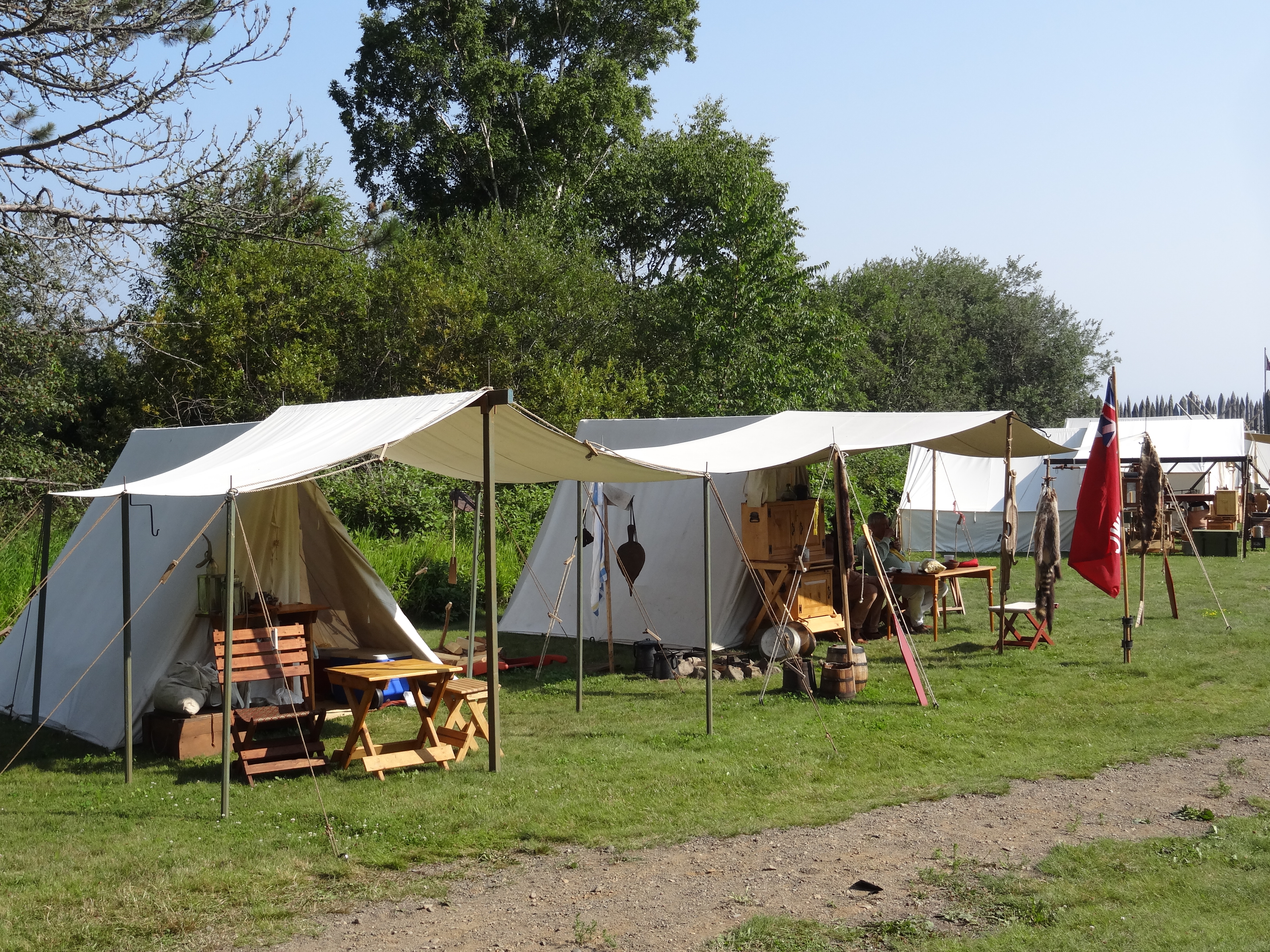
Every August, the NPS holds a big rendezvous, and you can visit with lots of reenactors and people in period costumes, etc. It's a lot of fun. They also had some exhibits set up about the native Ojibwe peoples.

its incredible how something seemingly insignificant (hats/fashion) really paved the way for the exploration of the North American continent


beautiful china in the dining hall


large collection of furs


rendezvous camp


Ojibwe wigwams, built out of birch bark


Bonus: head a few miles north of the National Monument to the Canadian border and visit Grand Portage State Park. Here, you can see the spectacular High Falls of the Pigeon River. It's a short hike, only a little over a mile.
Pigeon River. On the other side is the Canadian province of Ontario.


We saw this fox along the trail.


the impressive High Falls of the Pigeon River


For more info on Grand Portage National Monument: https://www.nps.gov/grpo/index.htm

Saturday, March 20, 2021

Klondike Gold Rush National Historical Park


Visited: June 2018
Nearby town: Skagway, AK

"There are strange things done in the midnight sun
By the men who moil for gold;
The Arctic trails have their secret tales
That would make your blood run cold;
The Northern Lights have seen queer sights,
But the queerest they ever did see
Was that night on the marge of Lake Lebarge
I cremated Sam McGee."
-from "The Cremation of Sam McGee" by Robert W. Service, a British-Canadian poet referred to as the Bard of the Yukon

Gold fever...it can drive people mad. The promise of incredible wealth drove many Americans west to California during the 1849 gold rush. As the 20th century approached, discovery of gold high in the Yukon, drove thousands of gold-seekers north to Alaska.

Alaska - that wild, incredibly vast and remote territory - was purchased by the USA from Russia in 1867. For decades, growth in this newly acquired territory inched forward at a snail's pace. By the late 1890s, all that changed. On August 16, 1896, a group of local miners, led by George Carmack and Skookum Jim, discovered gold in the Klondike River valley (near the present-day town of Dawson City) in the Yukon Territory, Canada. For the next 18 months, over 100,000 people stampeded their way from San Francisco and Seattle, on their way north to Alaska.

The tiny settlement of Skagway was the terminus of the boat trip from either San Francisco or Seattle, and the sleepy hamlet transformed into a boomtown. From Skagway, gold-seekers would hike either the White Pass or the steep Chilkoot Pass over the mountains, then to the Yukon River, and travel hundreds of miles downstream to Dawson City. It was a very long and arduous journey. Canadian officials required each prospector to bring a year's supply of food to make the journey from Skagway to Dawson City. These provisions would weigh nearly a ton. Prospectors would carry all this, usually by themselves, and would transport it in stages. The most memorable images of the Klondike Gold Rush are the long stream of prospectors heading directly up and down the steep mountain-side hauling all their gear and provisions on the Chilkoot Pass.

There was an alternative, all-water route from Seattle up to the Bering Sea and to the mouth of Yukon River. Then, one would navigate the Yukon River upstream all the way to Dawson City. This was an "easier" method, but it was prohibitively expensive, very long, and the window to do it was very narrow (most of the year, the Yukon River ices over and is not navigable). 

Many noteworthy people tried to strike it rich, including John McGraw (the second governor of Washington), Frederick Burnham (a scout and explorer who would later fight in the Boer War), and a 21-year old struggling author named Jack London. London did not strike it rich. However, he later wrote two books set during the Klondike Gold Rush, Call of the Wild and White Fang, that brought him great fame and success. 

Like London, most prospectors did not strike it rich. The conditions and the elements were incredibly harsh and many seekers were not even able to complete the journey to Dawson City. In 1900, the White Pass and Yukon Route Railroad was completed and made the trip from Skagway to the Yukon interior much easier. However, by then, the stories of failure had reached the mainland and discouraged many would-be prospectors, the gold mines dried up, and the Gold Rush quickly ended.

The Klondike Gold Rush National Historical Park tells the story of these prospectors and the colorful town of Skagway. Skagway is now a popular cruise ship stop. There's a good museum and you can stop by the historic homes and saloons, etc. Skagway was a wild, rough-and-tumble town. Lawlessness was rampant. During the height of the boom, June 1898, Skagway reached nearly 10,000 people and was the largest town in Alaska at the time. Today, the town has a year-round population of about 1,000.

depiction of prospectors heading up Chilkoot Pass


"House of Negotiable Affection" (aka a brothel)


this giant machine attached to the train would clear snow


We did an excursion and took a bus to Carcross, Yukon Territory. We got to see the beautiful mountains, lakes, a swinging bridge, and got to see some sled-dogs. It was a lot of fun.


the dunes of the Carcross Desert


the stunning colors of Emerald Lake


the small town of Carcross, Yukon Territory, Canada


The approach and departure on our cruise ship to Skagway was incredible. We had a great time in this corner of Alaska. Klondike Gold Rush National Historical Park also has a small unit in the Pioneer Square neighborhood of Seattle, Washington. There is a museum and visitor center. Link to more info: https://www.nps.gov/klgo/index.htm


Land of the Midnight Sun indeed.

"There's a land where the mountains are nameless,
And the rivers all run God knows where;
There are lives that are erring and aimless,
And deaths that just hang by a hair;
There are hardships that nobody reckons;
There are valleys unpeopled and still;
There's a land - oh, it beckons and beckons,
And I want to go back - and I will.

from "The Spell of the Yukon" by Robert W. Service