Monday, December 9, 2019

Biscayne National Park

Visited: Feb 2019
Nearby city: Homestead, FL; Miami, FL

This National Park in southeastern Florida preserves Biscayne Bay and the offshore barrier coral reefs. 95% of this park is water; a very tiny bit of the park is on mainland Florida (the Dante Fascell visitor center) and the remaining land are the small islands (called Keys) scattered throughout the Bay: the three main keys are (1) Boca Chita Key; (2) Sands Key; and the largest key in the park (3) Elliott Key.

In the early 1900s, the keys in this beautiful bay became somewhat of a playground for the wealthy elite and a popular vacation spot for luminaries like President Warren G. Harding, the prominent DuPont family, founder of Firestone Tire company Harvey Firestone, famous boxer Jack Dempsey, GM head Charles Kettering, founder of Goodyear F.A. Seiberling and humorist Will Rogers. As Miami's growth exploded in the 1950s and 1960s, development spread further and further south. Some power plants were built on the mainland along Biscayne Bay. And a plan was proposed to construct a giant causeway or bridge across the Bay connecting Key Biscayne to Key Largo. There were a number of influential people (such as landscape designer Ernest Coe, who was largely responsible for the creation of Everglades National Park) who lobbied to protect and preserve the Bay from this development. In 1980, Biscayne National Park was established.

Because so much of the park is water, if you don't have your own boat and watercraft, you'll need to book a guided tour. All tours leave from the Dante Fascell visitor center (the closet town is Homestead, FL about 1/2 hour-45 minutes south of Miami). Go to the park website for all the information on tours and links to other companies that are licensed to offer tours of the park. There are lots of different options: 1/2 day tours (or full day tours) to Boca Chita Key to see the lighthouse, or to Elliott Key for hiking. Other tours offer snorkeling (you can even snorkel shipwrecks in the Bay), or a trip out to Stiltsville (an amphibious neighborhood built out in the middle of the bay on 10-ft high platforms, 7 houses survive to this day).

We did the half-day tour out to Boca Chita Key. It was a beautiful ride across the Bay. The water was clear blue, and very shallow all the way out to the key, only about 8-10 ft deep, you could easily see the bottom. Way in the distance, you could see the towering skyscrapers of Miami on the horizon.


the Miami skyline in the distance


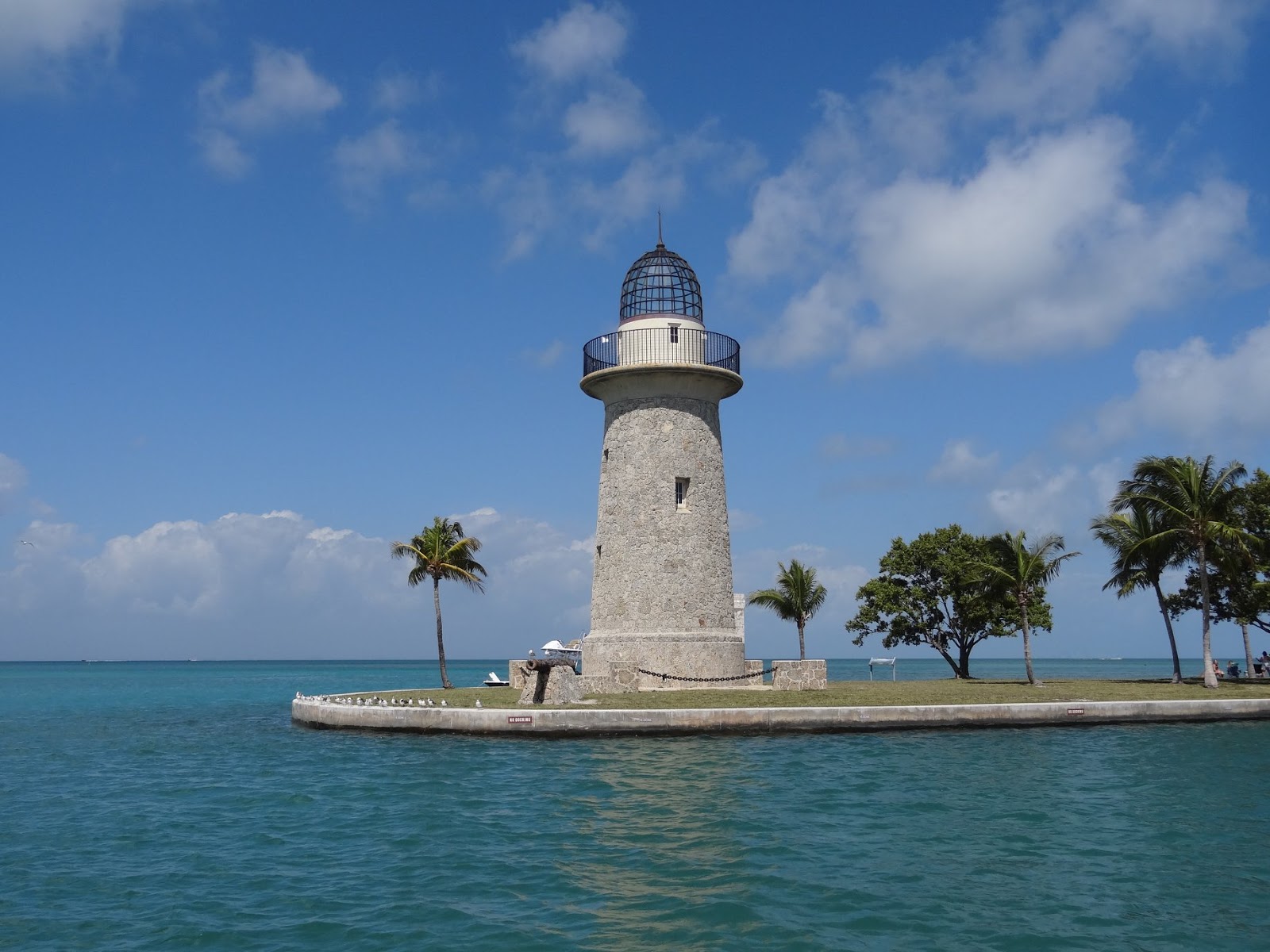
approaching Boca Chita Key


In 1937, industrialist Mark C. Honeywell purchased Boca Chita Key and turned it into quite the vacation getaway. Honeywell had made his fortune in hot water heating equipment. He would host elaborate parties on the island and built a number of structures, a few small homes, a church, and a lighthouse. It is not a functioning lighthouse, it is purely ornamental.

After your pleasant ferry ride across the bay, we had an hour or two to sit and enjoy the Key. Caught great views on top of the lighthouse, play in the ocean, or just wander on the Key to your heart's content. Boca Chita Key definitely retains its party atmosphere. Many local Miami-ans (Miami-ites?) had docked at the island, loud music playing, passing around the Coronas, etc. 😊 It was certainly a unique National Park atmosphere. 😃




Although our visit to Biscayne National Park was quite short; we had a fun time. Looking forward to returning and maybe doing some snorkeling or visit Stiltsville. Go to the park's website to find out all information on booking a guided tour. For more info: https://www.nps.gov/bisc/index.htm

Tuesday, December 3, 2019

Manzanar National Historic Site

Visited: Nov 2016
Nearby town: Lone Pine, CA

"My family and I were classified as enemy aliens simply because we looked like the enemy."
-former Congressman Mike Honda, who lived at an internment camp in southeastern Colorado as a young boy

The isolated and desolate Owens Valley, at the foot of the eastern edge of the Sierra Nevada in California, was the site of Manzanar, the largest camp used to relocate American citizens and immigrants of Japanese descent during WWII. From Dec 1942 to 1945, this rugged area was inhabited by over 120,000 Japanese-Americans, forced from their homes to relocate here due to rampant paranoia and prejudice.

This dark chapter of American history is memorialized at the Manzanar National Historic Site, preserving a history that needs to be encountered and studied, so hopefully it will never be repeated again.

I have covered most of the backstory of what lead up to the relocation camps in the blog post of our visit to Minidoka National Historic Site in Idaho. Instead of repeating the story I will simply leave a link to that post: https://paulnationalparks.blogspot.com/2018/10/minidoka-national-historic-site.html

Manzanar was a much bigger camp than the one in Idaho, and the visitor center here is much more developed and has more exhibits. Manzanar is the most comprehensive site for information on this episode of American history. The museum and grounds here is very somber and is a must-visit if you want to understand the relocation of Japanese-Americans to these camps.
After the attack on Pearl Harbor in Dec 1941 and Pres. Franklin D. Roosevelt issued Executive Order 9066, Manzanar was the first of 10 relocation camps to be built and established. Most of the Japanese-Americans that came here were from the Los Angeles area.

Life in the camp was rough: harsh conditions, harsh weather, and hardly any privacy. A number of families lived together in barracks. Food was heavily rationed, and people had to wait in lines to eat, to use the bathroom, to do laundry, etc. And they were continually monitored by guards in tall towers surrounding the camp armed with machine guns.
reconstructed barracks

communal kitchen

cafeteria


interior of barracks


names of internees who signed up to serve in the US Army
For recreation, the internees played sports (primarily baseball), held dances and musical concerts. Some changed the desert landscape next to the barracks into beautiful gardens, with pools, waterfalls, and rock ornaments. Remnants of these gardens are still present at the site.


Make sure to stop at the Visitor Center to watch the film and take your time to read all the exhibits. You really start to sense what these people went through and what life was like in these camps.


Make sure to take the drive through the camp and stop at the barracks and the cemetery towards the back end of the camp.

This monument at the cemetery was built in 1943, the inscription reads "Soul Consoling Tower"


"My Mom, Pop, and Me"

My Mom, Pop, & Me
Us living three
Dreaded the day
When we rode away,
Away to the land
With lots of sand
My Mom, Pop, & Me

The day of evacuation
We left our little station
Leaving our friends
And my tree that bends
Away to the land
With lots of sand
My Mom, Pop & Me

-Itsuko Taniguchi

Manzanar was closed on November 21, 1945 and the US gave each individual $25 for one-way fare back to their homes. Many returned to nothing, their possessions stolen, and their homes taken. Let us never forget what happens when other factors supersede the constitutional rights guaranteed to all citizens and aliens living in this country.