Sunday, September 19, 2021

Manassas National Battlefield Park

Visited: Sept 2019
Nearby city: Washington DC

"Today will be known as Black Monday. We are utterly and disgracefully routed, beaten, whipped by secessionists."
July 22, 1861 journal entry by lawyer and Union diarist George Templeton Strong

On a plain in northern Virginia, lies the site of the first major battle of the US Civil War. The Union referred to the battle as Bull Run (named after the river), while the Confederacy referenced the battle as Manassas (named after the small, nearby village). 

The outbreak of the US Civil War was caused by decades-long tensions between the States that centered around slavery, and also involved the conflict between the powers of the centralized federal government and the rights of the states, interpretations of the nature of democracy, socio-economic factors, class struggle, and a host of other complex issues. The election of President Abraham Lincoln in 1860 was a breaking point. Lincoln had run on a platform against the extension of slavery to the country's newly-acquired territories. White Southerners branded Lincoln and the new Republican Party as a dangerous abolitionist party that was intent on destroying the Southern "way of life." Before Lincoln took office in March 1861, seven states had seceded from the Union (South Carolina, Mississippi, Florida, Alabama, Georgia, Louisiana, and Texas). Virginia would soon follow, and seceded in April 1861. Ultimately, a total of eleven states would secede, and they formed the Confederate States of America. When Confederate troops fired cannon on a federal fort off the coast of South Carolina (Ft. Sumter) and the fort surrendered on April 12, 1861, the hostilies officially began. On May 8, 1861, the Confederacy moved its capital to Richmond, Virginia; only 100 miles away from the Union capital of Washington DC.

Union leaders believed a swift, frontal attack on the new capital of Richmond would lead to a quick end to the war. The show of strength and a victory would convince the South of the futility and error of their rebellion and the Union would be preserved. Union General Winfield Scott was a battle-tested veteran, but was 75 years old, and physically unable to lead the force. Lincoln needed to select a new commander, and had a short time to do so. Lincoln eventually selected Irvin McDowell of Ohio. McDowell had long served as an Adjutant General, but had little experience in command on the field of battle. McDowell was given little time to train the volunteer troops for the planned assault on Richmond, and was very concerned of both his own and his troops inexperience. Lincoln responded "You are green, it is true. But they [the Confederates] are green also; you are all green alike." 

On July 16, 1861, McDowell departed Washington DC with an army of approximately 35,000. About twenty-five miles down the road, McDowell and the Union Army met a Confederate force of 20,000, lead by Gen. P.G.T. Beauregard, at the Bull Run River near the small town of Manassas. Beauregard's makeshift headquarters was in a home owned by Wilmer McLean. A wholesale grocer, McLean later moved his family further south in order to avoid the bloodshed...he moved to the small town of Appomattox ... (*more about his story in a later blog post*).

As the battle began on the morning of July 21, 1861, the Union appeared to have the upper hand...but then Confederate reinforcements under Brig. Gen. Joseph E. Johnston arrived by railroad and boosted the Confederate numbers to about 32,000 - roughly the same number of troops as the North. The rejuvenated Confederates put up a stalwart defense against the Union's initial assault. 

A Confederate Brigadier General and professor at the Virginia Military Institute named Thomas J. Jackson waged a particularly famous defense at an area of high ground known as Henry Hill. Confederate Brig. Gen. Barnard Bee was in danger of being pushed from the field by the Union advance, and told Jackson (who had been sent to reinforce his troops) that the Enemy was driving them. Jackson replied "Then, Sir, we will give them the bayonet." Jackson stood strong against the Union assault, leading Bee to exclaim to his troops: "There is Jackson standing like a stone wall. Let us determine to die here, and we will conquer. Rally behind the Virginians!" Bee's description inspired the Confederate troops and the moniker would stick, Jackson would be widely known as "Stonewall" Jackson. Jackson later died from friendly fire at the Battle of Chancellorville a few years later, in May 1863. There is a statue of Jackson on the battlefield grounds.

The Confederates then launched a fierce counterattack that surprised and overwhelmed the untrained and undisciplined Union troops. McDowell, suffering heavy losses by the counterattack, ordered a retreat. The retreat was poorly managed, and the Southern newspapers referred to it as the "Great Skedaddle." In all, the Union suffered 2,700 casualties, the South suffered 2,000 casualties.

Lincoln and the Union leaders were shocked and dismayed by the rout. It was a swift and brutal realization that this would not a be a short war, and that the Confederacy was not going to quickly give up its cause and submit back into the Union. The Confederate celebration was also somewhat muted, they as well realized this would be a long, costly war, and that the North would not relent in their goal to preserve the Union.

Manassas National Battlefield Park was established in 1936. Unfortunately, we did not have a lot of time here, we made a quick visit to the Henry Hill Visitor Center - which has great exhibits, lots of information about the origin of the Civil War, the battlefield, and very good interactive maps. Its a great museum. There is also a 45-minute orientation video about the battle. We then walked the grounds at Henry Hill.

Henry Hill Visitor Center


During the battle, the Henry family home stood at this spot. The house was destroyed during the war, and the house seen here was rebuilt by the Henry family in the 1880s. The home served as the site's original visitor center when the Park was established in 1936. 


burial grounds of Judith Henry. Judith was living in the home at the time of battle. She was 85 years old, bed-ridden, and unable to leave the home as the battle commenced. Judith was mortally wounded when Union artillery crashed through the bedroom wall and tore one of her feet off. 


These grounds were also the site of the Second Battle of Bull Run/Second Battle of Manassas a little over a year later in August 29-30, 1862. It was another Confederate victory and emboldened Gen. Robert E. Lee to conduct the ensuing Maryland Campaign (that ended with the incredibly bloody Battle of Antietam ... more on that battle in an upcoming blog post). There are some more areas of the Park devoted to the Second battle, but we did not have enough time to visit.

If in Washington DC area, make sure to take some time and drive out here to learn about the beginnings of the Civil War.

Sunday, September 12, 2021

Casa Grande Ruins National Monument


Visited: June 2019
Nearby town: Coolidge, AZ; nearby metro: Phoenix, AZ

In the desert southeast of Phoenix, a large, ancient structure looms over the landscape. Casa Grande National Monument protects a number of Hokoham structures dating from around 1150 - 1450 AD.

We visited this site with my sister, Anna, and her husband Jason (who works for the NPS), and my nephew Chad. It was a quick visit, and it was an incredibly HOT day. 😀 But we had a good time.
Chad, me, Jason, and Anna at the entrance sign

Your first stop should be the Visitor's Center. They have a good museum and exhibits about the ruins and the Hokoham peoples. The Hokoham inhabited this area of the American Southwest from approximately 300 - 1500 AD. They were a distinct culture but similar to the Ancestral Pueblans (whose ruins include Mesa Verde, Hovenweep, etc.) and the Mogollon (Gila Cliff Dwellings, etc.). The Hokoham tamed this seemingly inhospitable desert and developed a complex and technologically advanced society for its time - it even included large-scale irrigation networks. 

example of Hokoham pottery

The centerpiece of the site is the eponymous "Big House" - a large structure made of caliche. The building consists of outer rooms, three-stories high, surrounding an inner structure. The inner structure is four-stories high, which would have made it one of the tallest buildings in North America at the time of its construction. The structure housed a number of families, essentially an entire community. There is also a ball court at the site (a popular sport among the Hokoham people). The adobe (mudbrick) that makes up the house has a very thick base, which adds significant strength to support the height of the structure. The Big House was abandoned around 1450 AD - likely due to a period of sustained drought.

The first European to see the ruins was Father Eusebio Kino in 1694. Kino, a Jesuit missionary, was instrumental in establishing missions throughout present-day Mexico and the American Southwest and traveled extensively in the area. He made detailed documentation of his travels and observations. He named the ruins "Casa Grande" (Spanish for "big house"). 

The ruins generated insterest for hundreds of years, and US President Benjamin Harrison protected the site via executive order in 1892. In a somewhat misguided attempt to stabilize and prop up the ruins, the US government added wooden beams and metal rods to buttress the structure. In 1918, President Woodrow Wilson re-designated the site as Casa Grande National Monument and put it under the administration of the NPS. In 1932, a ramada was built over the structure to shield it from the weather. The beams, rods, and the ramada are still present today. It is incredible that this structure still stands (and is so intact) after centuries and centuries.


Casa Grande National Monument is a good stop for an hour or two if in the area. For more info: https://www.nps.gov/cagr/index.htm

Sunday, August 22, 2021

Transcontinental Railroad - 150th Anniversary


"The last rail needed to complete the greatest railroad enterprise of the world is about to be laid. The last spike needed to unite the Atlantic and Pacific by a new line of travel and commerce is about to be driven to its place. To perform these arts, the east and west have come together. Never, since history commenced her record of human events, has she been called upon to note the completion of a work so magnificent in conception, so marvelous in execution ..."
-H.W. Harkness, a Sacramento newspaper publisher and editor, at the "Golden Spike" ceremony

May 10, 1869 - the day that the Transcontinental Railroad was finished.

The trip from the East Coast to the West Coast - which took nearly 6 months - now only took a little more than a week. This created a monumental change in American transportation, economy, technology, communication, and culture. 

To learn more about this gigantic project and the NPS unit, here is the link to my previous blog post on our first visit to Golden Spike National Historical Park. 

The two lines - Union Pacific Railroad and the Central Pacific Railroad - met each other about 66 miles northwest of Salt Lake City, Utah, at a place called Promontory Point. The Union Pacific Railroad began construction in Omaha, Nebraska and proceeded west (the laborers were predominantly Irish immigrants), and the Central Pacific Railroad began construction in Sacramento, California and proceeded east (the laborers were predominantly Chinese immigrants). 

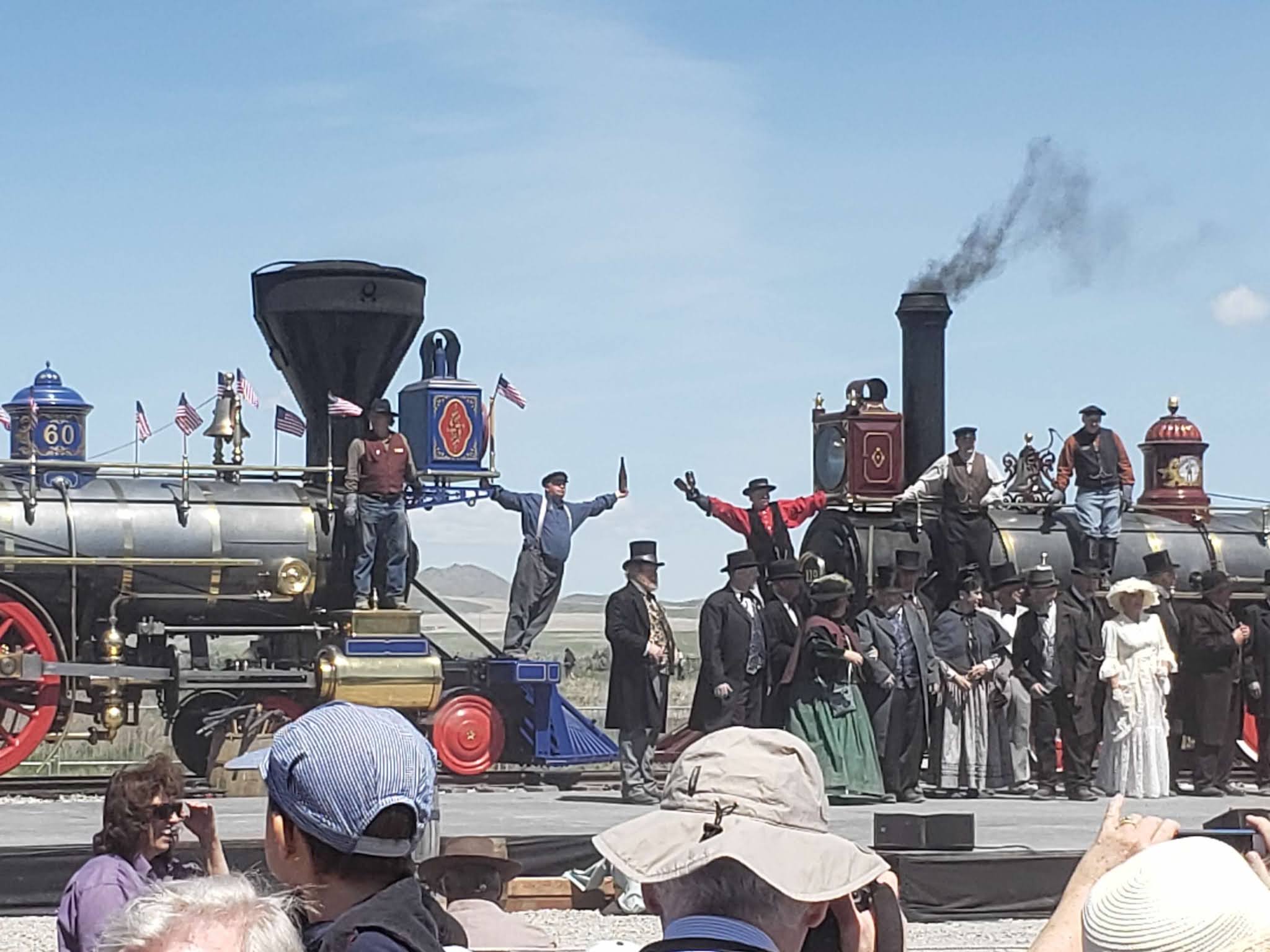
On May 10, 2019, there was a huge celebration commemorating the 150th anniversary of this great accomplishment. Tara and I went with Tara's parents. There were lots of great temporary exhibits set up detailing the history of the project, the culture of the American West, and how the completion of the transcontinental railroad changed the nation.


As the construction neared its completion, four special spikes were made to be presented at the ceremony: a Golden Spike from California; Silver Spike from Nevada; and a gold and silver spike from Arizona. 

On May 10, 1869, the ceremony began, emceed by wealthy Sacramento banker Edgar Mills. Two locomotives - the Union Pacific No. 119 and the Central Pacific Railroad #60 AKA "Jupiter" - were brought to the meeting point. Speeches were delivered by (1) Dr. H.W. Harkness, a Sacramento newspaper publisher; (2) Leland Stanford, Governor of California, and President of Central Pacific Railroad; and (3) Gen. Grenville Dodge, Union Pacific Railroad's Chief Engineer. The four special spikes were officially presented to Stanford. They were placed in the tie and given gentle taps by a silver-plated hammer known as a maul, for ceremonial purposes only. The precious spikes were then taken out and replaced by actual railroad spikes to place in the ties. The last spike, and the hammer, were wired to a telegraph line so the entire Nation could "hear" the blows driving in the spike as it happened. It was essentially the first mass-media event. Stanford was given a chance to hammer the last spike, but his swing missed the spike and hit the tie instead. Union Pacific Vice President Thomas Durant was also given a chance to hammer the spike. But Durant had partied hard the night before, and had a severe headache. He did worse than Stanford, his swing was so off, not only did he miss the spike...but he didn't even hit the tie! 😀 Finally, an actual laborer stepped in and officially completed the railroad. The telegrapher then sent the long-awaited message "D-O-N-E" on Monday, May 10, 1869 at 12:47 pm. 

The golden spike is now located at Stanford University. However, the Visitor Center at the NPS site does have a replica of the golden spike. 

We had a great time at the celebration, there was lots of live music, tributes to the sacrifice of the laborers who made the railroad possible, and a fun show with music and dancing. The replicas of the locomotives are truly beautiful and fantastic. I recommend heading to Golden Spike National Historical Park to see the re-enactment of the ceremony. They are held throughout the summer.


Tara and her mom.