Visited: Sept 2017
Nearby town: Hodgenville, KY
“‘The short and simple annals of the poor.’ That’s my life and that’s all you or any one else can make of it.”
-Abraham Lincoln’s response to a reporter, during the 1860 campaign, when asked about his youth, quoting from “Elegy in a Country Churchyard” by Thomas Gray
Abraham Lincoln, our nation’s 16th president (1861-1865), is easily one of our most famous and greatest leaders. His election in 1860 prompted many southern states, convinced that Lincoln would abolish slavery, to secede. Lincoln did not wish to go to war, but he knew that the integrity of the Union must be preserved. He refused to recognize the legitimacy of the southern state’s actions, and considered them in rebellion. In order to quash that rebellion, Lincoln ultimately realized that slavery must be abolished. He boldly waged a war with the express purpose of liberating the enslaved. The Emancipation Proclamation, the Gettysburg Address, 13th amendment, Homestead Act, and the policy and strategy enacted to win the Civil War: Lincoln’s contribution to the country is impossible to overstate. When he was killed by John Wilkes Booth shortly after the conclusion of the war; the entire world mourned. In many ways, it continues to mourn his tragic and abrupt end.
The humble beginnings of this great president is here in rural central Kentucky. In these rolling bluegrass hills, Abraham Lincoln was born on February 12, 1809. Lincoln’s parents, Thomas and Nancy, lived in a small log cabin on Sinking Spring Farm, just south of the small village of Hodgenville. Abraham had an older sister, Sarah, who was born two years prior; and a younger brother, Thomas Jr., who died as an infant in 1812. Thomas Lincoln worked as a farmer and a carpenter, but struggled to provide for his family. Thomas was uneducated and never learned how to read, however he was generally respected in the community for his civil service and story telling ability. Abraham recalled times in his youth when “my toes stuck out through my broken shoes in the winter; when my arms were out at the elbows; when I shivered with the cold.”
Thomas struggled mightily to own property in Kentucky. Boundary and land disputes in the Sinking Spring Farm forced the Lincoln family to move a few miles north to the Knob Creek Farm. It was at this farm that Abraham had his first memories of his youth. Thomas’s legal troubles continued, as it turned out that Thomas had defective title in the Knob Creek Farm. After a long court battle, and with Thomas unable to pay legal fees, the family lost the farm and moved to Indiana in 1816, when Abraham was 7 years old.
Abraham’s parents were faithful members of the Little Mount Baptist Church, a congregation that had separated from the larger Baptist Church over the issue of slavery. The Little Mount Baptist Church refused to support slavery. Despite growing up in a slave state, Abraham’s parents exposed him to anti-slavery sentiments and beliefs at a very young age, thanks to the influence of this abolitionist sect.

A statue of Lincoln’s family at the birthplace visitor center. Thomas, older sister Sarah, and Nancy holding baby Abraham.
The Abraham Lincoln Birthplace National Historical Park preserves both of these farms where Lincoln lived in Kentucky: (1) the birthplace site on Sinking Spring Farm and (2) Knob Creek Farm. They are only about 10 miles apart, so be sure to visit both of them.
The Sinking Spring Farm contains a very good visitor center with a film about Lincoln’s family and hardscrabble life. Watch the film and go through the exhibits. There are also plenty of Ranger Programs and Guided Walks to learn more about the life of our most celebrated president.
The cornerstone of the Memorial marking Lincoln’s birthplace was laid on the centennial of his birth, February 12 1909, by President Theodore Roosevelt. The Memorial was completed in 1911 and dedicated by sitting President William Howard Taft. The Memorial officially became a part of the National Park Service in 1933.

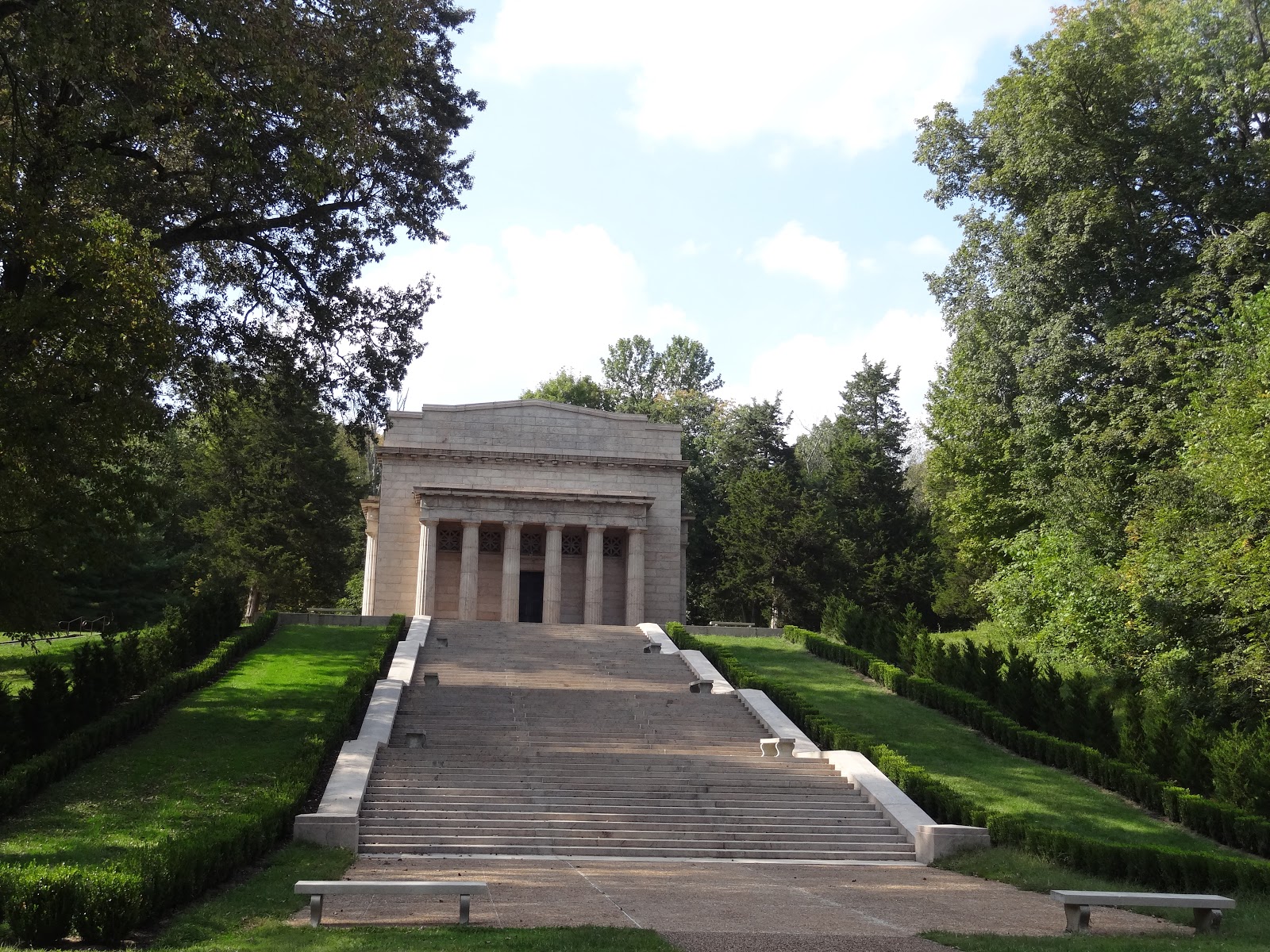


56 steps lead up to the memorial (56 being Lincoln’s age at the time of death). The building itself has 16 windows and 16 rosettes on the ceiling (to represent that Lincoln was the 16th president). The design obviously inspired the much larger Lincoln Memorial in Washington DC.
Inside the memorial is the log cabin where Lincoln was born* (NOTE: more on this later) 😄


In the years after Lincoln’s death, many wished to commemorate the cabin where Lincoln was born. They quickly discovered that the cabin had been dismantled long before, but locals claimed that the logs of the original cabin (aka “Lincoln Logs”) had been re-used to construct other cabins in the area. In 1894, wealthy New York businessman Alfred W. Dennett, purchased as much of these “Lincoln logs” he could find, and constructed a cabin out of them and took it across the country, touting it as the birth cabin (or at least, made out of the logs of the birth cabin) of the great leader. This “Lincoln log” cabin was eventually placed here when the Memorial was dedicated in 1911. As the years went by, and the claims of authenticity became more and more suspect (even way back in 1911, Lincoln’s son Robert Todd Lincoln was very skeptical that the Lincoln logs were authentic), the NPS decided to test the logs. In 2004(!), tree-ring sampling verified that the logs dated to 1848...decades after Lincoln was born. Obviously, this is not the actual cabin, nor is it made out of “Lincoln logs”...however, it is certainly symbolic of log cabins of the early 19th century, and likely looks similar to the log cabin that Lincoln was born in. But don’t let that fact burst your bubble 😄 This is still a cool site.
Spend some time to walk around the grounds of the Sinking Spring site, and then head over to the Knob Creek Farm. Here you will also find a reconstructed cabin (unlike the birth home, no one had ever claimed this cabin to be authentic). The good thing about this reconstruction is that they have built it according to recollections of this cabin from Lincoln’s own writings.


Lincoln lived at a cabin at Knob Creek from ages 2 to 7. Lincoln’s very first memories are from the time he lived on this simple home and farm. He recalled walking to school (it was 2 miles away), planting pumpkin seeds, and picking berries in the hills. He recalled sitting next to the fireplace at night, learning to read and write. The school he and his sister attended was a subscription school, and Abraham’s family could only afford for them to attend for a few months. Abraham had a passionate drive to be educated; even at a young age. Largely due to the fact that his father was not.
The farm was situated on the Bardstown - Green River Turnpike, part of the Cumberland Road. It was along this path, that young Abraham first saw slaves, being taken down the road further south to be sold in New Orleans.
Take some time to walk the grounds here. Walk down to Knob Creek.


Lincoln remembered his mother warning him many times to not play in Knob Creek. As most boys do, he didn’t listen. 😄 One day, when the creek had swollen near to its banks, Abraham and a childhood friend and neighbor, Austin Gollaher, were playing on some large trees that had fallen across the river. Abraham lost his balance and fell in. Neither boy could swim. Austin’s quick thinking saved the day. Austin managed to find a long tree limb and hold it out to Abraham so he could climb out to safety. Austin Gollaher lived in Hodgenville the rest of his life, passing away in 1898 at the age of 93. He became legendary in the small town, and would often regale tourists with the drowning incident and other stories (he might have embellished some). He liked to boast that he had saved Lincoln, and thus saved the Union. 😀
Walk around the grounds, they are beautiful.


Since I was a small boy, I have always been interested in the life and times of our nation’s presidents. The Abraham Lincoln Birthplace National Historical Park is just one of many sites dedicated to our 16th president. This is a fun and entertaining visit to learn about the humble origins of one of the greatest leaders of all-time. More info here: https://www.nps.gov/abli/index.htm